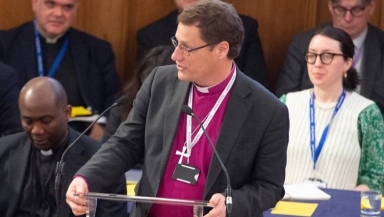
Yesterday the Bishop of Leicester, Martyn Snow, tried to reset the ongoing Living in Love and Faith (LLF) debate, asking the General Synod of the Church of England "to be reconciled with God and show this by being reconciled to one another".
He talked of the missionary imperative of the Church finding a way to 'agree to disagree' and pleaded for Synod to avoid "a series of speeches simply saying, 'Synod needs to agree with me', or others just need to change their mind".
But the problem facing the Church is, as Ed Shaw said, "We do not all believe the same things when it comes to identity, sexuality, relationships and marriage."
He moved an amendment that asked the General Synod to recognise that for many of their number, "Some of the issues raised are not matters on which they can simply agree to disagree,"
He explained the problem: "We have been implicitly and explicitly told that we can agree to disagree; that these issues do not matter too much; that they are not issues of primary importance; that they do not impact the gospel; that we do not need to change our doctrine or structures.
"But they are issues of primary importance for so many of us, from a range of different perspectives; they do impact our understanding of the gospel; they are leading to change in our doctrine and our structures will, I'm afraid, need to follow.
"My amendment simply seeks to be honest about the depth of our current division."
In a bizarre turn of events, Synod proceeded to vote against the amendment – in effect denying the existence of the very Synod members who moments before had stood before them and explained why they could not agree to disagree. Twenty of the thirty-four bishops present voted this way.
Despite all his talk of not using speeches to call on others to change their mind, Bishop Snow led the charge against Shaw's amendment.
In his response, the bishop explained that while he acknowledged the truth it contained, he could not support it because he "feared that enshrining this in the motion is rather a counsel of despair, of saying there aren't any new and imaginative ways for us".
Synod member, Rev Graham Kirk-Spriggs, went further, describing any form of differentiation that recognised that this was an issue on which people could not in conscience agree to disagree as "a disturbing development", "structural prejudice" and "entirely un-Anglican".
He went on to challenge the orthodox bishops, saying, "Bishops, you have a choice, once you put on that purple shirt, once you are given a mitre and staff, you can either be a focus for unity or factionalism – not both."
It seems that the only acceptable "new and imaginative" ways forward are those which rely on people agreeing to disagree. This places conservative members of General Synod, whether bishops, clergy or laity, in a very difficult place as the debate resumes this morning.
Susie Leafe is director of Anglican Futures, which supports orthodox Anglicans in the UK.