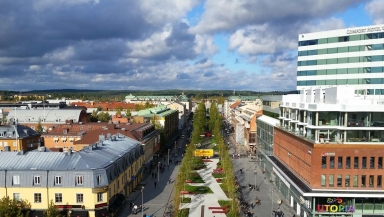
A Jewish community association in northern Sweden has decided to close following a series of threats from far-right activists, seven years after it opened.
The centre in the town of Umea was targeted with Nazi swastikas and daubed with messages such as 'we know where you live'.
Local members said the authorities had failed to provide enough security.
A community spokesperson, Carinne Sjoberg said that some people no longer dared to come to the centre.
She said that a Neo-Nazi group, Nordfront, was behind the hate campaign which initially targeted her and then other members of the community too. She added that the windows of a community member's car were broken at the weekend.
Members of the community 'started to feel they didn't want to bring the children,' Sjoberg told the BBC.
'My mother and father are [Holocaust] survivors, so this is not OK. Enough is enough. It was like stepping into their shoes in the 1930s,' she added.
Umea previously hit the headlines two years ago when a march was held to mark the anniversary of Kristallnacht, the outbreak of mass violence against Jews in Nazi Germany in 1938.
Sjoberg said that despite the closure of the centre, the community would aim to have a meeting place in the future that was more central in Umea and easier to protect.
Jewish community leaders say that the situation is tense for Jews in some Swedish towns.
'We've had problems with neo-Nazis in Gothenburg and Umea, but in other cities like Stockholm we feel safer,' said Isak Reichel, the secretary general of Sweden's central council of Jewish communities.
He told the BBC that for Jews in the southern city of Malmo, the threat was mostly from Islamist groups.