Dozens of Chaldean Christians could be among victims of Donald Trump's 'Muslim ban' with more than 100 arrested and due to be deported back to Iraq.
Activists warn sending the detainees back to Iraq is a 'death sentence' after the US Immigration and Customs Enforcement (ICE) began a crackdown in Detroit.
Immigration officials claim all of those arrested had criminal convictions and it appears the mass detentions are linked to Trump's stalled travel ban.
Iraq was initially one of the seven Muslim majority countries where citizens were barred from entering the US but was removed for the second order.
This was because the country agreed to take back deportees who were living in the US without proper documentation.
'As a result of recent negotiations between the US and Iraq, Iraq has recently agreed to accept a number of Iraqi nationals subject to orders of removal,' an ICE statement reads.
It adds the recent arrests were part of processing a 'backlog' and insisted all had convictions 'for crimes including homicide, rape, aggravated assault, kidnapping, burglary, drug trafficking, robbery, sex assault, weapons violations and other offenses'.
But many of those arrested committed minor crimes which date back several years and were not threats to society, the local Chaldean Bishop Francis Kalabat said on Monday.
'The Church does not oppose justice, all hardened criminals that are a danger to society should be picked up,' he said.
'Many who were picked up are not hardened criminals but for the last decades have been great citizens.
'The genocide bill that was just passed by Congress last week to protect Christians goes against this very thing.'
Martin Manna, president of the Chaldean Community Foundation, warned deporting these Christians back to Iraq is 'equivalent to a death sentence'.
He told ThinkProgress: 'There are laws that pertain to deportation, but there also laws that pertain to human rights.
'The conditions in Iraq have worsened, they have not improved, especially for Christians.'
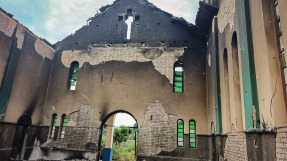
The Chaldean Church is an ancient Christian tradition in communion with the Roman Catholic Church. Its members have lived in Iraq for centuries but have faced sustained persecution, in particular from ISIS which gave them the choice of death, conversion of paying a special tax.
The persecution reached such intense levels that the US administration declared ISIS' treatment of Chaldean Christians among others as a 'genocide' – a declaration that was also backed by the EU Parliament.
Detroit holds around 150,000 Chaldeans, the largest population outside the Middle East.
Manna said that many of those detained have lived in the US since they were children and, aside from persecution, would not be able to speak their native language in Iraq.
'Most of those being picked up or at risk of deportation have only really known America,' he said. 'They came here as children. They're culturally illiterate [in Iraq]...There's really no homeland for the Chaldean people.'