
The National Aeronautics and Space Administration (NASA) continues to learn more and more about other planets in the Solar System, thus expanding mankind's understanding and appreciation of the Universe that only God could have created.
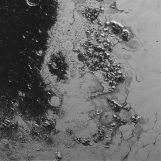
After announcing its confirmation of the presence of liquid water on Mars and the great lakes that the Red Planet used to have billions of years ago, the space agency then disclosed another tantalising finding of the farthest working probe it has in space—the New Horizons spacecraft that recently visited what used to be known as the farthest planet in our Solar System, Pluto. The New Horizons probe is already heading outward and further into space but it still sends data on the many findings it collected on Pluto. The latest images it relayed to NASA headquarters showed numerous "small, exposed regions of water ice" on the surface of Pluto.
Jason Cook, a science team member of the Southwest Research Institute (SwRI) in Boulder, Colorado, explained that the new findings were brought about by data collected by a high-tech imaging device on New Horizons called the Ralph spectral composition mapper.
The new images of Pluto's surface showed traces of red water ice in some areas of the dwarf planet. Cook said space scientists are puzzled why such water ice is coloured red and why it only existed in some parts of Pluto.
"Large expanses of Pluto don't show exposed water ice, because it's apparently masked by other, more volatile ices across most of the planet. Understanding why water appears exactly where it does, and not in other places, is a challenge that we are digging into," the space researcher said.
Silvia Protopapa, a science team member from the University of Maryland, College Park, is particularly wondering why the areas showing the most obvious water ice spectral signatures correspond to areas that are bright red in recently released colour images.
"I'm surprised that this water ice is so red. We don't yet understand the relationship between water ice and the reddish tholin colorants on Pluto's surface," Protopapa said.
Aside from the discovery of water ice, NASA also found out that just like on Earth, the sky over Pluto is also blue. The space agency saw this using the first colour images of Pluto's atmospheric hazes taken by New Horizons
The first colour images of Pluto's atmospheric hazes, returned by NASA's New Horizons spacecraft last week, reveal that the hazes are blue.
"Who would have expected a blue sky in the Kuiper Belt? It's gorgeous," Alan Stern, New Horizons principal investigator, said.
Although the haze particles found on Pluto were likely red or gray, they scatter blue light, tickling the curiousity of the New Horizons science team. Researcher Carly Howett said this phenomenon may indicate the size and composition of the haze particles.
"A blue sky often results from scattering of sunlight by very small particles. On Earth, those particles are very tiny nitrogen molecules. On Pluto they appear to be larger — but still relatively small — soot-like particles we call tholins," Howett explained.