Every time I visit Liverpool, which isn't often these days, I am always amazed at her unique spirit.
Yesterday, I was invited as a guest of Liverpool's Metropolitan Cathedral to a 50<sup>th-anniversary performance performed by their own choir together with Westminster Cathedral Choir from London.
As usual the staff at Lime Street Station were more than helpful and as I walked up Brownlow Hill towards the Cathedral, I was full of anticipation.
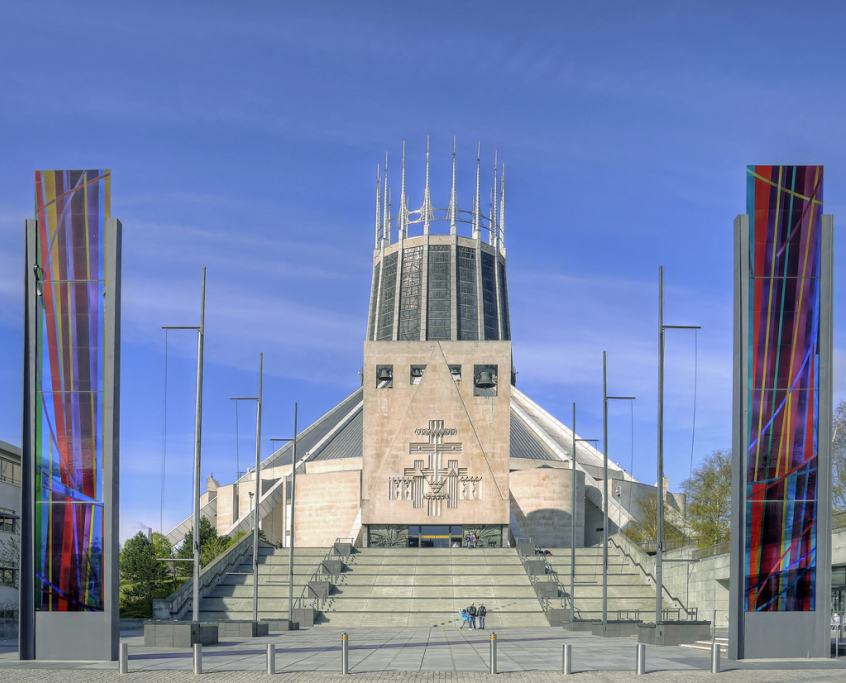
The Cathedral's assistant musical director, James Luxton, met me on arrival and took me for coffee at a newly-opened Starbucks over the road, where he filled me in on the musical history of the Cathedral, which was opened for the first time in 1967.
The unique informality of Liverpool was evident in the seating arrangements for the evening, which unlike in other Cathedrals I've visited, were completely haphazard and based on trust.
And this worked beautifully.
Various members of the audience offered their views on the event and when I asked the name of one of them, he turned out to be Patrick Kelly, former Catholic Archbishop of the city.
The choirs performed Mozart's Requiem, conducted by Dr Chris McElroy, their Director of Music who, in addition to his musical talents, has completed a PhD on the reception of Vatican II in England and Wales.
And at the end a complete stranger, who turned out to be the mother of the Head Chorister, offered me a lift back to Lime Street Station.
For 10 years I taught Biblical Hebrew and cognate subjects in the university building adjacent to the Cathedral, the students comprising a good mix of Catholic priests, Anglicans, Jews, taxi drivers, professors and people who simply wanted to know the Bible in its original format.
Those were 10 of the best years – not once was there any trouble – and the university even paid for me to attend the Nobel Peace Prize Ceremony in 1991 to which I had astonishingly been invited by the Nobel Committee.
When I suggested that Welsh should be added to the university language curriculum, this was also taken up with alacrity. Nothing, it seemed, was too much trouble for Liverpool!
There is no doubt that Liverpool is a city of enterprise – but not enterprise as we know it. It is a city of faith, hope and love in every sense – where I as a Jew always felt more than welcome – and no more so than last night.
And when in 2007 I taught music to Arab children in Jaffa, and concentrated on the Beatles in order to improve their English, it was this spirit of Liverpool that I tried to convey to a new generation in a different world.
And two years later in Tel Aviv, when Tony Blair addressed the dinner to celebrate the inauguration of the Palestinian-Israeli Chamber of Commerce, and Cherie invited me to attend, the joint Arab-Jewish choir which was the centre of attraction, cried out 'Dr Lancaster: Yellow Submarine!'
What is it about Liverpool which helps to bind across barriers? People say that it is the Celtic spirit. I have no idea – but a German friend summed it up best: 'eigenartig'.
Liverpool is simply one of a kind.
Dr Irene Lancaster is a Jewish academic, author and translator who has established university courses on Jewish history, Jewish studies and the Hebrew Bible. She lives in Greater Manchester and is chair of the Broughton Park Dialogue Group which just celebrated its ninth anniversary.