The vast majority of Americans pray. But how do they do it, and what do they pray for? New research has shed light on the intercessory habits of Americans.
A comprehensive study by Barna, published this week, suggests that for most Americans prayer is solitary and silent.
The June survey of 1,015 US adults found that most (82 per cent) said they most often prayed silently and alone, while only 13 per cent prayed audibly and alone. Just two per cent said they most often prayed 'collectively with a church' or 'audibly with another person or group'.
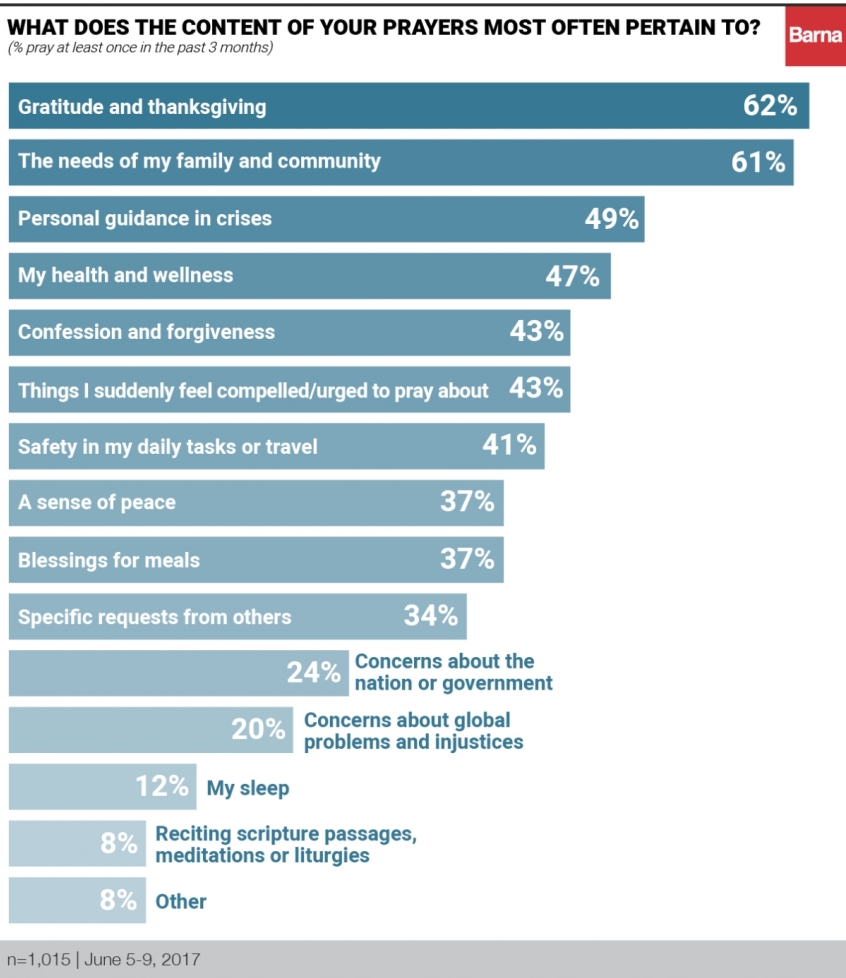
The most common content of prayers is 'gratitude and thanksgiving' (62 per cent), and 'the needs of my family and community'. Personal guidance in crises takes precedence (49 per cent), while there seemed to be less of an imperative for praying for the requests of others (34 per cent), concerns about the government (24 per cent), global injustice (20 per cent) or reciting Scripture or liturgies (Eight per cent).
Different social groups pray in varying ways. Among denominations, evangelicals were the most enthusiastic about every listed prayer category, while generally women are more likely than men to cover every listed prayer category in their intercessions.
When it comes to praying globally, liberals are more likely to pray for global injustices (26 per cent) than conservatives (19 per cent), and black people more likely to do the same (27 per cent) than white people (19 per cent).
In contrast, conservatives are more likely to pray for the nation or government (29 per cent) than liberals (20 per cent), and those with a college education or higher are less likely to do the same (17 per cent) than those with a high school education or less (26 per cent).
When it comes to directing prayers, 90 per cent aim their prayers simply to 'God'. Fewer people (50 per cent) pray to Jesus, while 23 per cent pray to 'the Holy Spirit'. Five per cent pray to 'the saints', while the same percentage pray to a generic higher power. Three per cent pray toward a 'divine power within myself', 'ancestors' or 'the universe'. One per cent pray to Allah. Of the 1,015 surveyed, 888 were self-identified Christians or 'past Christians'.
'Prayer is by far the most common spiritual practice among Americans,' said Barna's editor in chief, Roxanne Stone. 'The vast majority of Americans—no matter their religious affiliation or non-affiliation—participate in some kind of prayer activity. Barna has found this to be true consistently over the last several decades. The numbers have barely changed from year to year. Which made us wonder: what do people mean by prayer? What do these prayers actually look like? And who are they praying to?'
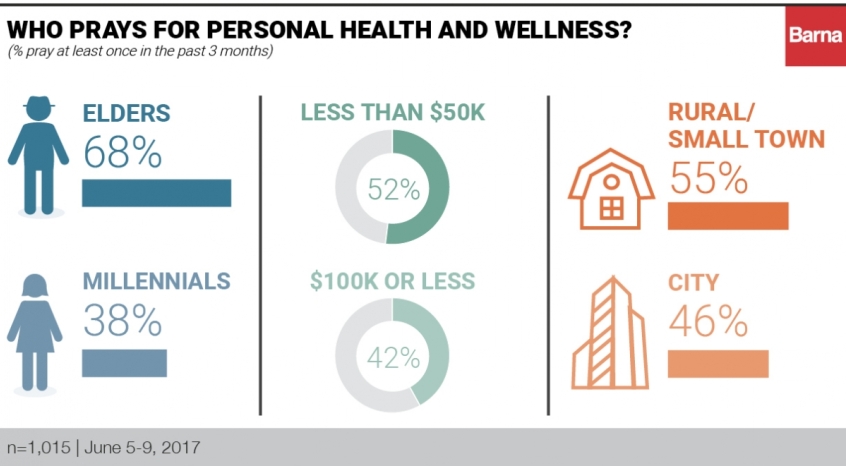
She added: 'What we found gives us a much more nuanced portrait of the American prayer life. The most notable aspect of which is it's individual quality. People pray mostly alone—it is a solitary activity defined primarily by the immediate needs and concerns of the individual. Corporate prayer and corporate needs are less compelling drivers in people's prayer lives.'
Stone inferred some positive findings from the study, as well as challenges for churches and their pastors.
'The good news: People have active and personal prayer lives. They are engaging with God outside their houses of worship and around the most intimate and vulnerable areas of their lives. But what would it look like to begin to broaden the scope of those prayer lives? To consider the power of corporate prayer—when more than one are gathered in God's name? How can we turn our collective prayers toward broader world issues and injustices? How do our prayers help others in times of crisis?
'Such questions can enliven prayer lives and embolden people to believe the power of their prayer,' said Stone.
The complete Barna study can be read here.