With all the upheaval caused by vaccine mandates culminating in the recent glorious U-turn, a strange phenomenon has occured.
A bit like the moment when the drilling in the background stops, or when your local curry house turns up their air conditioning in a bid to get you out the door, I knew something had changed but have only just realised what it was.
The bodily autonomy argument, which until recently was exclusively used to justify the killing of unborn children (which are understood incorrectly as being part of the mother's body) has found itself suddenly under new (and I'd argue better) management.
This has caused total infuriation among those adamant that the phrase belongs to pro abortion feminism only, with one journalist describing the appalling sight of a "my body my choice" placard being wielded at a freedom march as "borrowed rhetoric, exploiting pro choice politics in order to defend the right to get their family sick".
But to whom does the phrase truly belong? Or to whom should we give custody moving forward? Well, in order to work this out we need to understand the arguments better.
On the one hand the bodily autonomy argument insists that control of one's own body is a sacred right that mustn't be tampered with or taken away by anyone. While the ideology offers dignity and protections against strangulating religious or cultural precepts, rape, domestic abuse or unfair working hours, it has been most commonly utilised in reference to sex.
In fact 'my body my choice' has become shorthand for a women's right to not only sleep with whoever she wants to but to kill any unintended humans that may result from that decision.
Those who don't want to be injected with the experimental covid jab have repeatedly insisted on social media that to be coerced through threat of unemployment, into being jabbed is a specific violation of their "bodily autonomy".
What is fascinating about the way Covid jab refusers are using slogans is the different way in which they are being applied. The following table is my attempt at capturing this:
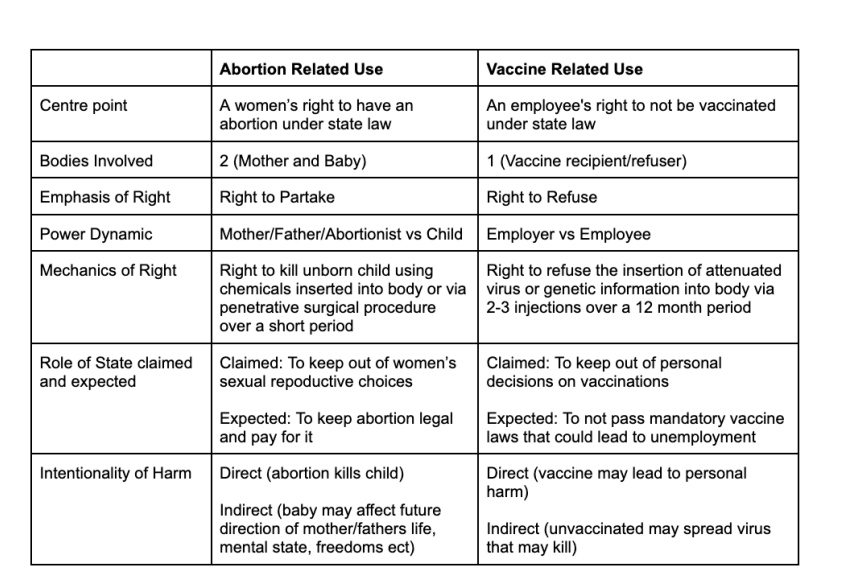
Yet in a remarkable turning of events, rather than seeing the common ground in the way the phrase is now being used (or even acknowledging the greater sincerity with which it is now being used), proponents of bodily autonomy in regard to abortion but not vaccines, instead insist that control of one's body must never override the greater good of others.
To put one's preferences or fears above the lives of others, it is argued, is tantamount to pure selfishness.
The right to intentionally kill unborn babies is reserved, the right to unintentionally pass on a virus, which under exceptionally unlikely circumstances may kill, is lambasted as morally wrong.
However, while all this exposes the fact that 'our truth' may not belong to us after all, I think it reveals a deeper truth. Far from belonging to either camp, have we considered that the phrase actually belongs to God?
Amidst all this confusion, it's no surprise that over the last two years the bodily autonomy slogan finds itself either quarantined away or bobbing up and down at freedom marches.
As evangelist Glen Scrivener's interview with historian Tom Holland helpfully points out, both the bodily autonomy argument and vaccine mandates, while distorted, fundamentally have their roots in good Christian thinking.
The right of an individual to decide his or her own fate without being coerced, manhandled or exploited by another is a profoundly Judeo-Christian notion, pre-dating the enlightenment by a few thousand years.
As is the notion that, while possessing total bodily autonomy by nature of being human made in God's image, we should not hoard it, but instead willingly and joyfully lay it down in the service of others.
This means that what we are seeing played out before our eyes as we speak is not just a display of flagrant insincerity but in actual fact hopeless uprootedness.
While some, no doubt, are actively perverting these arguments to spill the blood of the most innocent and barbarise the lives and conscience of the faithful, others are going along with this evil simply because they have lost the connective framework on which these arguments actually work.
This is why the Church's responsibility is not to condemn such slogans, but to reconnect them with the one who actually gives the slogan meaning.
The change of hands of the slogan is certainly a step in the right direction. However its proper meaning and the parameters of its use can never be fully established without reference to the God that gave it birth.