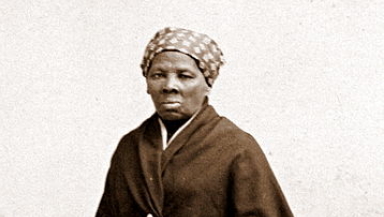
I recently watched the film Harriet based on the true story of Harriet Tubman. I was inspired and, having since researched her, Harriet has now become one of my Christian heroes.
Harriet was born into slavery in Maryland as Araminta Ross; she later changed her name to Harriet and took the Tubman from her husband. It is typical of Harriet's lowly status as a black slave that no one recorded the actual date of her birth in 1822. Like most slaves, Harriet received no education and was to remain illiterate all her life.
She began work at the age of five as a housemaid and soon suffered all the brutalities of slavery: starvation, whippings, beatings and a particularly severe head injury that left her with lifelong problems. Yet amid this suffering, she was part of a dynamic church culture that gave her a firm faith in Christ. Harriet became a woman with a personal relationship with Christ; she sought his guidance and frequently had vivid visions.
Harriet grew up in tumultuous times. The United States was becoming deeply divided over slavery: while the southern states supported the practice, the northern ones banned it and granted slaves freedom. As a result, an increasing number of slaves in the southern states chose to flee northwards on the long and dangerous route to liberty and freedom.
When Harriet was in her late twenties, she felt God urging her to flee. Guided by God and carefully avoiding the brutal slave catchers by using the organised network of guides and safe houses that came to be called the Underground Railroad, she fled to Pennsylvania.
She was later to describe her feelings on crossing the boundary: 'When I found I had crossed that line, I looked at my hands to see if, now I was free, I was the same person. There was such a glory over everything; the sun came like gold through the trees, and over the fields, and I felt like I was in heaven.'
Then, suddenly aware that she had to survive on her own, she prayed, 'Oh, dear Lord, I ain't got no friend but you. Come to my help, Lord, for I'm in trouble!'
At liberty, Harriet decided to rescue those she had left behind. So for 11 years she made dangerous journeys into Maryland, travelling in winter nights and hiding from slave hunters and their dogs. She brought out family, friends and strangers through the Underground Railroad. She made 19 expeditions south, escorting over 300 slaves to freedom.
Among her own people she acquired the nickname of 'Moses' because of her role in bringing them to the 'Promised Land'. Her success and her ability to avoid escape became legendary. In part it was due to God guiding her and her courage, intelligence and determination. She was also helped because the increasingly troubled slave-owners came to believe they were dealing with a powerful man rather than a small black woman. Typically, Harriet attributed her success to the Lord's protection. Soon slave-owners posted wanted notices in which tens of thousands of dollars were offered for her, dead or alive.
When in 1861 the tensions over slavery erupted into the Civil War, Harriet aligned herself to the Union Army of the north. With them she served as a laundress, cook and nurse but increasingly as scout and spy. Familiar with the terrain and used to concealing herself within it, she located Confederate military positions and even guided raids into the south; on occasions wearing a uniform. In one remarkable raid, she led an armed assault on a collection of plantations that successfully liberated 750 slaves. The idea that an American military operation might be led by a small, black, illiterate civilian woman might seem unbelievable, but truth is often stranger than fiction. In admiration, Harriet found herself called 'General Tubman'.
Harriet spent her latter years in good works with her church, campaigning for the fair treatment of African-Americans and promoting women's rights. She died on 10 March 1913 and was buried with military honours.
How does Harriet Tubman inspire and challenge me?
- Harriet was full of faith. Harriet may have been illiterate but throughout her life she drew on rich resources of Christian faith and personal experience. God sustained her in war and peace and guided her.
- Harriet triumphed over extraordinary difficulties. Harriet was born into slavery and poverty, had no education and suffered much, including an almost crippling physical injury. Yet for all the little she had – or perhaps because of it – God was able to do great things through her.
- Her faith in Christ gave her courage. Harriet had the courage to carry out daring actions in perilous situations; she also had the courage to keep on battling on issues over years. Many of us could use a dose of that courage today.
- Harriet didn't get too comfortable. When Harriet reached freedom, she could have stayed there. Instead she chose to make repeated return journeys to bring others to liberty. The idea that if you are saved you should save others is a good one.
- She resisted hate. The greatest danger in combating evil is that in the struggle you can become evil yourself. So many of Harriet's abolitionist contemporaries felt it was justifiable to kill slave-owners. She drew back from that: she shunned hatred and revenge. Her Christian faith gave her not just a resolve but also restraint. It's a good lesson.
Harriet Tubman was a woman who found herself at the heart of monumental issues. Despite being ill-equipped in almost every way, she leaned on God and was able to serve with remarkable success. We face very different battles than Harriet did, but we serve the same God. Let's hear God's voice like Harriet did and do his will with wisdom, patience and courage.
Canon J.John is the Director of Philo Trust. Visit his website at www.canonjjohn.com or follow him on Facebook, Instagram or Twitter.