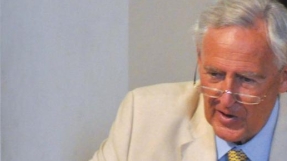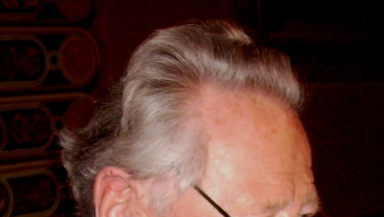
Hans Küng, a controversial Swiss Catholic theologian, professor and priest, who was once censured by the late Pope John Paul II, has died at age 93.
Küng, who was known to be critical of Catholic theology, passed away at his home in Tübingen, Germany, on Tuesday, according to a report by Vatican News.
Pope Emeritus Benedict XVI, himself the subject of critique by Küng, released a statement quoted by Vatican News commending the late theologian for trying "to revive the dialogue between faith and the natural sciences and to assert, with regard to scientific thought, the reasonableness and necessity of the Gottesfrage (the question about God)."
Roger Haight, a Jesuit and scholar in residence at Union Theological Seminary in New York, wrote Tuesday that Küng was "no passive pietist, nor did he lack self-confidence."
"Like the course of emergent complexity in evolution, one can detect an expanding capaciousness in the tasks that Hans Küng undertook in the course of his amazingly productive career as theologian, ecumenist, religionist and finally a moral leader of humanity," wrote Haight.
"... the Catholic Church, Christianity, other religions and all humanity in a recognizable way are his beneficiaries."
Born in Sursee, Switzerland, on March 19, 1928, Küng became a priest in 1954 and then a professor of Catholic theology at the University of Tübingen.
He participated in the Second Vatican Council, where he first dialogued with Cardinal Joseph Ratzinger, who later became Pope Benedict XVI.
Küng garnered much controversy in the Catholic Church for his criticism of certain teachings, notably the concept of Papal Infallibility, which claims that when speaking on matters of faith the pontiff cannot err, as well as mandatory clerical celibacy.
In December 1979, not long after Pope John Paul II became head of the Catholic Church, Küng was censored by the Sacred Congregation for the Doctrine of the Faith.
"Küng, in his writings, has departed from the integral truth of Catholic faith, and therefore he can no longer be considered a Catholic theologian nor function as such in a teaching role," declared the Congregation at the time.
Despite the differences with high-ranking Church authorities, Küng continued to write, teach and critique the Catholic Church, all while remaining a priest.
"Many Catholic theologians have no longer critically examined the infallibility ideology for fear of ominous sanctions as in my case, and the hierarchy tries as far as possible to avoid the subject, which is unpopular in the church and in society," wrote Küng for the National Catholic Reporter in 2016.
"That is why the following question is more urgent than ever: Where is the church — which is still fixated on the infallibility dogma — heading at the beginning of the third millennium?"
In 2017, as the start of the Reformation turned 500, Küng advocated for reconciliation between the Catholic Church and Protestant denominations.
This included a call to overturn Reformation era excommunications of Protestant leaders, to formally recognize Protestant ministries, and to advance "mutual Eucharistic hospitality."
"May the pressure exerted by theologians, grass roots Christians, Christian communities and many committed men and women help the church leadership in Rome and elsewhere, which is so often hesitant and afraid, not to miss this historic opportunity but to wake up," he wrote, as quoted by The Tablet.
"In today's world, Christianity will only come across as credible if it presents itself in truly reconciled diversity."
Courtesy of The Christian Post