"Good disagreement" is a catchphrase doing the rounds at moment.
The Archbishop of Canterbury made it the central focus in his attempt to steer the Church of England through its ongoing debate on gay marriage. The Church's process of "shared conversations", an effort to reconcile opposing views on sexuality, "has at its heart a search for good disagreement", said Welby.
The buzzword has stuck. Andrew Goddard and Andrew Atherstone compiled a book called Good Disagreement in mid-2015. A number of senior Anglicans contributed to the book, which explored the history and structures behind disagreement and reconciliation, another buzzword for Welby's tenure as Archbishop.
Now the motif has extended to politics. Christians in Politics (CiP), a cross-party charity that aims to excite Christians about political engagement, recently launched a "disagree with tea" video. Andy Flannagan, director of both CiP and Christians on the Left, said "better tone" was needed in politics but that only came from better relationships.
"When you put relationships with political enemies first, you will continue to disagree but better language and better discourse will follow. What happens is a sharpening of each other's opinions in a better way," he told Christian Today.
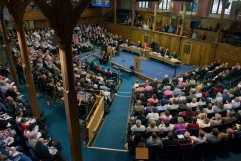
And now the #DisagreeWell tag has entered the debate on the EU referendum. On Thursday night a "Christian EU debate" was held with the event billed as a model for how to "disagree well".
As the debate unfolded it became clear just how subjective a term it is. "Oh grow up!", Ann Widdecombe, for the Brexit side, told the Remainers. But Sal Brinton, Lib Dem peer and EU supporter, was not to be outdone. "The reason Ann [Widdecombe] never lost her seat in the House of Commons is because we don't have a fair voting system," she said.
To what extent this is just lively debate and to what extent it crosses the threshold of good disagreement was unclear.
Giles Fraser, another Brexiteer at the debate, made the point that lively disagreement did not mean it was not good disagreement.
"I hate the idea Christianity is about being nice to each other," he said. "That is the essence of middle-class Britain but not the essence of Christianity. Sometimes the debate ought to reflect certain passion and vigour."
The convenor of the debate, Adrian Hilton, agreed the undeniably lively debate had been "iron sharpening iron". He concluded: "There has been more light than heat than at any point so far in this debate."
And he was right. No one could deny the intensity and passion on both sides of the debate. "To tell our European neighbours we think we're better off without them would be against our national principle," said Stephen Wall for the Remain side. Fraser retorted: "I would rather eat grass for a year in order to leave the EU."
For some last night's debate would have crossed the threshold of "good disagreement". But that would be a misunderstanding of the phrase. Good disagreement does not mean no disagreement and neither does it mean passive disagreement. Good disagreement can be feisty and it can be passionate. The difference with good disagreement is that both sides don't resort to personal attacks. They recognise the other side has a legitimate case and argue against that.
However lively last night's debate was, it never descended to the dark side of vitriolic abuse and straw man assumptions seen in the mainstream political debate. More light than heat indeed. The disagreement was intense. But it was also good. The Church of England could take note.