God's great work: NASA verifies 1,284 new planets, its largest collection ever

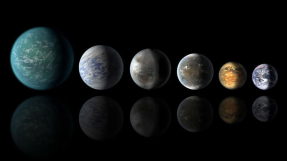
This artist's concept depicts select planetary discoveries made to date by NASA's Kepler space telescope. (NASA/W. Stenzel)

Here's another proof of God's great and immense work in our universe.

The National Aeronautics and Space Administration (NASA) recently announced that it was able to verify 1,284 new planets—the largest collection of planets it has ever revealed to date.

The discoveries were made by the Kepler Space telescope, a powerful astronomical device with a capacity to identify 4,302 potential planets which were placed in the July 2015 planet candidate catalogue.

The 1,284 new planets were given a verified status after they were found to have a 99 percent probability that they were indeed actual planets.

This does not mean that the remaining candidates are not actual planets. Some 1,327 candidates do not meet the 99-percent threshold, and would have to be studied further. A total of 707 candidates, however, were classified to be some other astrophysical phenomena.

Paul Hertz, Astrophysics Division director at NASA headquarters, said in a statement on the NASA website that this recent discovery bolsters the belief that a lot of exoplanets really exist.

"Before the Kepler space telescope was launched, we did not know whether exoplanets were rare or common in the galaxy. Thanks to Kepler and the research community, we now know there could be more planets than stars," Hertz said.

"This knowledge informs the future missions that are needed to take us ever-closer to finding out whether we are alone in the universe," he added.

Ellen Stofan, chief scientist at NASA Headquarters in Washington, meanwhile said the recent findings increase the probability that there is another planet out there similar to Earth. In fact, 550 out of the 1,284 new planets were found to be rocky and similar to Earth.

"This announcement more than doubles the number of confirmed planets from Kepler. This gives us hope that somewhere out there, around a star much like ours, we can eventually discover another Earth," Stofan said.


related articles
NASA finds atmosphere in a \'super-Earth\' — but it\'s dry and can\'t sustain life
NASA finds atmosphere in a 'super-Earth' — but it's dry and can't sustain life

NASA finds atmosphere in a 'super-Earth' — but it's dry and can't sustain life

One in quintillions: The Earth is a unique planet in the universe, astronomers find out

One in quintillions: The Earth is a unique planet in the universe, astronomers find out

Hell in space? Astronomers discover alien planet with sea of molten lava despite great distance to its parent star

Hell in space? Astronomers discover alien planet with sea of molten lava despite great distance to its parent star

Scientists see bigger chances of finding intelligent life outside Earth: Exoplanets\' discovery changes outlook
Scientists see bigger chances of finding intelligent life outside Earth: Exoplanets' discovery changes outlook

Scientists see bigger chances of finding intelligent life outside Earth: Exoplanets' discovery changes outlook

Alien life possible: 3 Earth-like planets found in \'habitable zone\' around dwarf star
Alien life possible: 3 Earth-like planets found in 'habitable zone' around dwarf star

Alien life possible: 3 Earth-like planets found in 'habitable zone' around dwarf star

News
Shine Your Light Christmas outreach campaign exceeded all expectations

300,000 Christians were involved in the various outreach events.

Most Americans don't believe faith in God is necessary to be moral

A record majority of Americans now say that it isn’t necessary to believe in God to be moral and have good values, but this view is primarily held by individuals who already don't believe in God, according to new data from the Pew Research Center.

Three and a half years of silence, fear, and faith: Mishal’s escape from forced detention

Abducted at the age of 18, Mishal spent three and a half years in forced confinement, enduring physical torture, religious coercion, threats, humiliation, and isolation before finally escaping with her baby daughter in her arms.

Pipe organs could be extinct by 2070

The pipe organs that remain are largely unused.