Is it a crime for a schoolteacher to teach students about evolution? Can creationism be questioned? The infamous American trial that debated the very question began on this day in 1925.
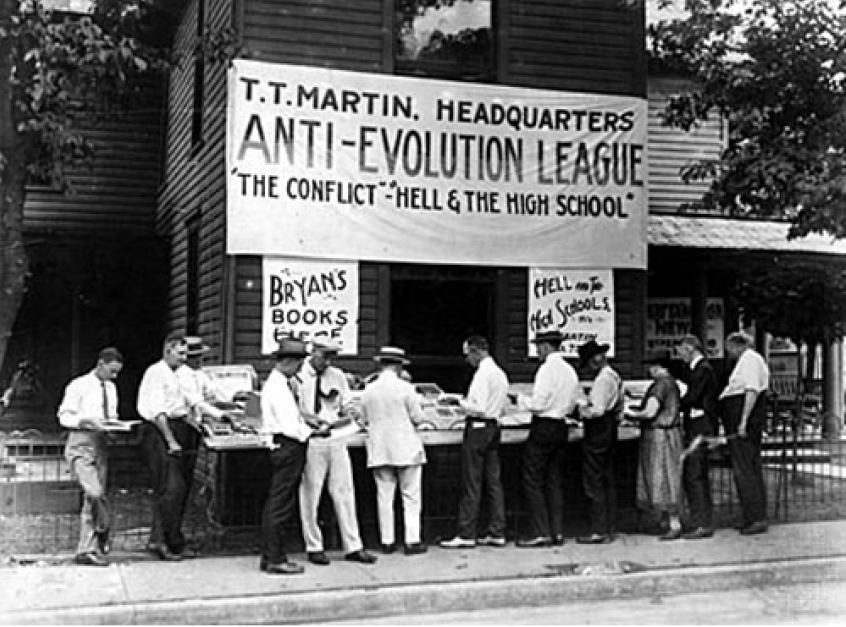
The Scopes Monkey Trial began as a legal dispute but turned into open-air theatre that became for many symbolic of the clash between science and fundamentalist faith.
John Thomas Scopes was a young high-school science teacher in Dayton, Tennessee. He was accused of violating a state law that made it illegal to 'teach any theory that denies the story of the Divine Creation of man as taught in the Bible, and to teach instead that man has descended from a lower order of animals'.
It's unclear whether Scopes had actually taught evolution, but he had deliberately incriminated himself to publicly challenge the law. The prosecutor appointed was William Jennings Bryan, a three-time Democrat candidate for the presidency and fundamentalist advocate. Opposing him, the famed agnostic lawyer Clarence Darrow defended Scopes.
The trial generated vast publicity, soon outgrowing the confines of the Rhea County Courthouse and turning into an open-air contest, with an audience of thousands, on the courthouse lawn.
In a dramatic twist, Darrow was able to put Bryan on the stand and publicly mock and interrogate him about science and his biblical fundamentalist beliefs, much to the delight of the crowd.
Bryan objected that Darrow was attempting to 'cast ridicule on everybody who believes in the Bible'.
Darrow hit back that he was rather 'preventing bigots and ignoramuses from controlling the education of the United States'.
The victory technically went to Bryan in the end: Scopes was declared guilty and had to pay a fine of $100, approximately $1,400 today.
In a gesture of generosity, Bryan actually offered to pay the fine due to Scopes. But his adversarial stand at the court became his enduring legacy – he died on July 26, within a week of the trial's end.
The dramatic debate reflects a chasm that still endures today in America, with passionately-held positions on science, religion and education continuing to conflict.