A new survey has polled the views of American military members on Christian faith and the Bible. Most military members have a 'very positive' view of believers, and say that American morality is in decline, while nearly half believe Bible doesn't have enough influence on society.
The study by Barna Group, released this month, explores the attitudes of US military personnel, past and present, and their perspectives on contemporary religion.
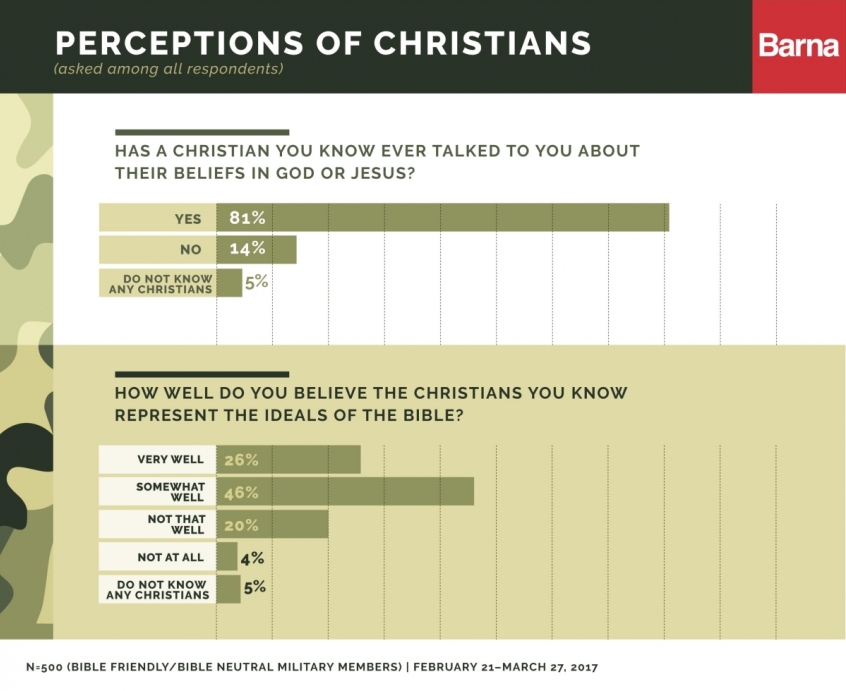
Most (76 per cent) said they knew 'faithful' Christians, and among those who said so 78 per cent said they knew such people in the military – just five per cent of respondents did not know any Christians at all. These relationships apparently tend to be good – most (55 per cent) said they had a 'very positive' perception of the believers they knew. Eighty-one per cent said that a Christian they knew had talked to them about their beliefs in God.
Such evangelical interactions are positive too, generally leaving people feeling affirmed (31 per cent), inspired (29 per cent), curious (26 per cent) or uplifted (23 per cent).
Among those who are either 'friendly' or 'neutral' towards the Bible, most (86 per cent) believe that American morality is in decline. Such a view is most common amongst those who are retired or have been discharged from the military (91 per cent) or those who are 'born-again' Christians (92 per cent).
Many also believe the Bible could be part of the solution. A little less than half (46 per cent) of service men and women said the Bible has too little influence in US society – though 22 per cent said the Bible has 'too much' influence, and 33 per cent said its influence was 'just right'.
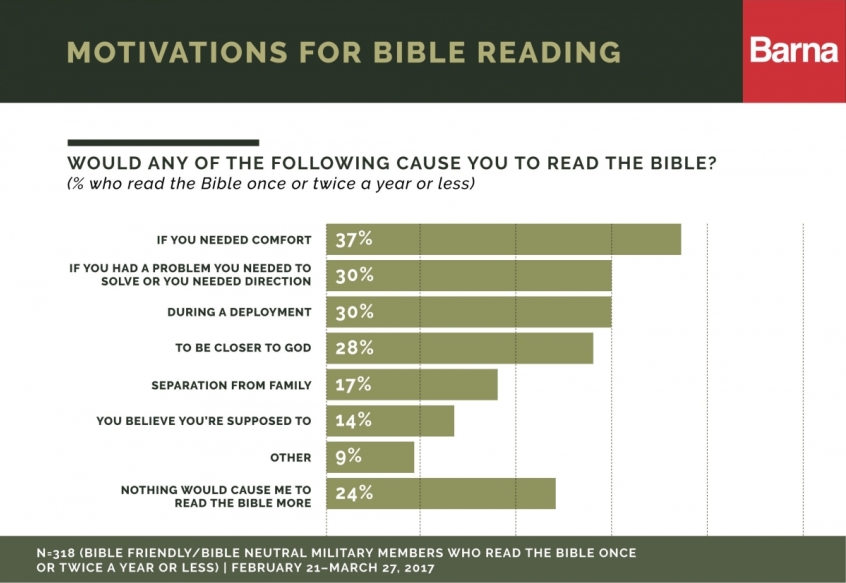
For those who turn to Scripture only infrequently, the most common reason to do so would be for comfort (37 per cent), or seeking life direction (30 per cent). Just over a quarter (28 per cent) seek Scripture in order to be closer to God. When it comes to defining the Bible, respondents were most likely to say it is the inspired word of God, free from error – granted that some of it should be taken symbolically (35 per cent).
The survey also explored how military life shapes identity. Central to the self-perception of many is their military profession (53 per cent), followed closely by American heritage/nationality (51 per cent). Religion was foundational for 31 per cent of respondents.
The full Barna study can be read here.