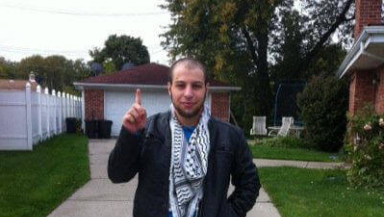
A 21-year-old American Muslim who "loves to hear people begging and screaming" has admitted to the FBI that he intends to shoot up a church full of Christians in Detroit.
According to affidavits filed in U.S. District Court in Detroit, Khalil Abu-Rayyan from Dearborn Heights, Michigan, said he had already selected a church for his massacre plan. He said it was located less than a half-mile from his place of employment. He even indicated the reason why he chose this church: It was large – up to 6,000 members – and an easy target, WND reported.
"A lot of people go there. Plus people are not allowed to carry guns in church," Abu-Rayyan was quoted as saying in court records documenting his Internet conversations with an undercover FBI agent.
"Plus it would make the news. Everybody would've heard. Honestly I regret not doing it. (If I) can't go do jihad at the Middle East, I would do my jihad over here," he said.
Assistant U.S. Attorney Ron Waterstreet testified before a federal magistrate on Feb. 16 that Abu-Rayyan told an undercover agent that he was "hearing voices" that told him to "burn people alive," the Detroit News reported. He also told the agent that "shooting and death make me excited. I love to hear people begging and screaming. ... I wish I had my gun."
"His dream was beheading someone," Waterstreet said. "This is not a person the court should take a risk (with)."
After hearing the FBI testimony, the judge ordered Abu-Rayyan held without bail, saying he was too much of a threat to public safety.
Since late 2014, Abu-Rayyan had been using Twitter for "retweeting, liking and commenting" on Islamic State (ISIS) propaganda, according to the FBI. Among his posts were "video of a Jordanian fighter pilot being burned alive, men being thrown from a high-rise building to execute them, the beheading of Christians in Egypt and news of ISIL victories," the Detroit News reported.
Abu-Rayyan has not been charged with any terrorism-related crimes so far, only with possession of a weapon while under the influence of illegal drugs.
He faces up to 10 years in a federal prison if convicted of that charge.
According to Abu-Rayyan in his statement to the FBI, his plans to shoot up a church were thwarted by his father.
"I tried to shoot up a church one day," Abu-Rayyan is quoted as saying in court records. "I don't know the name of it, but it's close to my job. It's one of the biggest ones in Detroit. Ya, I had it planned out. I bought a bunch of bullets. I practiced a lot with it. I practiced reloading and unloading. But my dad searched my car one day, and he found everything. He found the gun and the bullets and a mask I was going to wear."
In social-media conversations with the undercover agent that took place over several weeks in December, "Abu-Rayyan consistently expressed support for [ISIS] and repeatedly expressed his desire to commit a martyrdom operation," according to the affidavit.
He told the undercover FBI source about carrying a "large knife or sword in his car" in case of a fight and said "it is my dream to behead someone," according to the court documents.