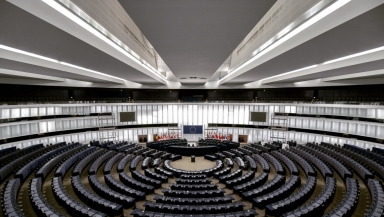
The European parliament has voted in favour of a non-binding parliamentary resolution that refers to abortion as a human right.
The resolution passed by 378 to 255 votes and came on the same day that a referendum in the British Overseas territory of Gibraltar voted to legalise abortion.
The European Parliament Women's Rights and Gender Equality Committee (FEMM) approved the 'report on sexual and reproductive rights' and the draft resolution submitted by Croatian MEP Fred Matić, on 11 May.
The resolution also called on EU member states to recognise access to abortion "in line with international human rights standards". Matić's report also criticises the so-called "conscience clause" of many abortion laws, which permits medics to refuse to facilitate abortions, often "on grounds of religion or conscience". It also 'urges' member states to 'decriminalise abortion, as well as to remove and combat obstacles to legal abortion', and even described the denial of abortion care as "a form of gender-based violence".
The report was largely an attempt to confront member states such as Poland and Malta where abortion is illegal or tightly restricted, and whose laws are specifically criticised in the report's explanatory statement.
The vote followed an intense debate in the chamber, in which many MEPs criticised the text of the resolution.
The centre-right European People's Party and the European Conservative and Reformists (The ECR Group) offered two alternatives to Matić's text, both of which said rights to abortion and reproductive services are the responsibility of individual countries to decide on, not the EU.
The ECR group explained that abortion "does not have the status of a human right under international law […] and the case law of the European Court of Human Rights and the Court of Justice of the European Union".
Spanish MEP Rosa Estaràs Ferragut said during the debate ahead of the vote. "Abortion is not a human right.
"It could be a legal right, that's accepted in some member states, but it's not a human right."
She added: "You can't ideologise a human right, this is not democracy and this is not what I want to see in Europe."
Grégor Puppinck, director of the European Centre For Law and Justice said, "It is a frightening text because it presents abortion as something that is good, something we wish for, something desirable like a type of freedom."
On 17 June, Slovakian MPs passed a resolution affirming to MEPs and MPs in EU countries their stance that "issues concerning health policies and education are in the competence of nation states".
Maltese group Doctors for Life also criticised the report for failing to safeguard conscientious objection, and for interfering with "Member States over the definition and management of their domestic health systems or their national health policy choices", and represented a "totalitarianism of values".
They also argued that the report "[…] attempts to introduce the recognition of a right to abortion", although no such right exists, nor can it be derived from the Universal Declaration of Human Rights or the Charter of Fundamental Rights of the European Union. On the contrary, since the 1994 Cairo Conference, states have committed themselves to "reduce the recourse to abortion" and to "take appropriate steps to help women avoid abortion".
They explained how the report intentionally misleads politicians and the public by "repeatedly conflating gender equality and basic human rights with abortion", adding that, "This rationale makes the rejection of abortion equivalent to an unwillingness to grant equality or essential human rights and is a strategy employed repeatedly to compel others to accept such proposals."
A spokesperson for Right To Life UK, Catherine Robinson said: "The attitude of the MEPs who supported this resolution is abysmal, and mirrors precisely Westminster's aim in imposing radical abortion laws on Northern Ireland.
"It is clear that many EU politicians wish to impose abortion on countries such as Poland and Malta, despite the fact that the overwhelming majority of their voters are against such a change. Moreover, it is a blatant attempt to designate abortion as beyond debate, by enshrining it as a fundamental human right that cannot be violated. This is outrageous. Abortion is not a human right, but is in fact the violation of the unborn child's right to life."
Courtesy of Right to Life UK