The cathedrals of England are not 'too big to fail' the Archbishop of Canterbury has warned.
The warning came in a letter in which Archbishop Justin Welby made clear the Church of England will not rescue Guildford Cathedral, which has an annual deficit of £100,000, from the financial difficulties it is currently in.
Welby, writing before a planning meeting where Guildford councillors refused permission for a housing development next to the cathedral, said: 'Naturally there are ways of offering assistance and advice, but it is extremely unlikely that any part of the Church would be able to compensate financially for the effects of this development not going ahead.
'I hope that anyone who has been misinformed on this point will understand that the future of Guildford's Cathedral rests very much in the decision the council makes.'
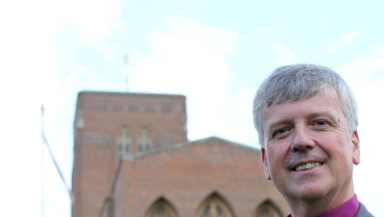
The cathedral, designed by Sir Edward Maufe and built in the last century in the brutalist style of the period between the two world wars and the 1960s, is arguably one of the Britain's ugliest. It does look beautiful at night, however, when lit up by numerous electric lights, and when it is a sight to contemplate for drivers as they whiz past on the nearby A3.
It is also spacious and aesthetically pleasing to some on the inside, although the acoustic qualities of such a cavernous space can present challenges for the choir and those listening or singing in the congregation.
Welby continued: 'I appreciate the striking picture that Guildford Cathedral makes, sitting alone on its hill. However this picture is not one that the cathedral wishes to present; it wishes to be rooted deeply in providing solace and joy to all who live in its diocese. Cathedrals are living buildings which thrive on welcoming people in; medieval cathedrals are often crowded around with houses, as at Lincoln or York.'
Christian Today reported that Guildford Cathedral faces possible closure after councillors at the planning meeting turned down the scheme to build new 134 homes on Stag Hill that would have given the cathedral £2 million and an annual income of a few hundred thousand pounds.
However, even the development would have fallen well short of the £17.2 million needed to save it.
Planning permission for the new housing development was refused even though Bishop of Guildford Andrew Watson said there was a real possibility of the cathdral 'closing its doors' as a result.
One way it was financed was by inviting people to 'buy a brick' for Guildford.
In his new book, England's Cathedrals, former Times editor Simon Jenkins writes: 'As a child, I "bought a brick" for Guildford. When later taken to see it in place, I was mortified. It was lost among millions of bricks, among cliffs of interminable, relentless brickwork. Disappointment still hangs about this place, lonely on its hill outside the town.
'Cars stream along the A3 below, scarcely noticing. Even the approach road has been likened to the entrance to a crematorium.'
Jenkins gave it just one star in his five-star cathedral ratings guide in the book, making it equal bottom with others such as Derby and Bradford, and also Brentwood Roman Catholic Cathedral.