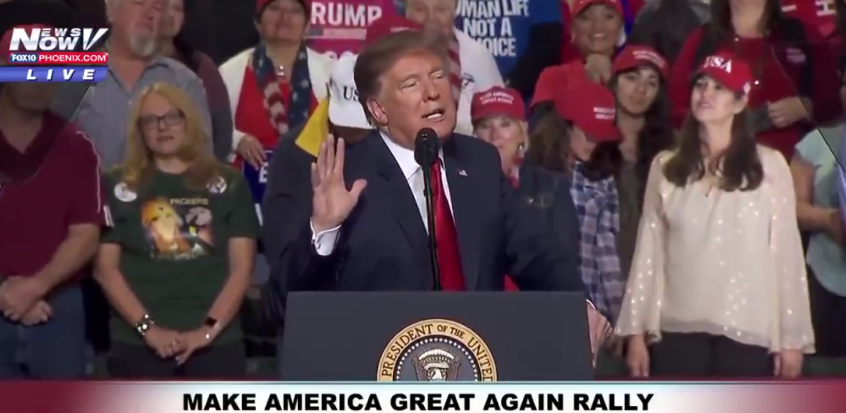
Support for Donald Trump among white evangelical Protestants has fallen by 9 percentage points since 2017 - but more non-white Catholics are getting behind the president, new figures show.
In February 2017, Trump's approval rating among white evangelicals stood at 78 per cent, but by last month, this had fallen to 69 per cent.
The dip in support among white evangelical Protestants is the biggest among the racial religious demographic groups surveyed by the Pew Research Center. Support among white Catholics also fell from 52 percent in 2017 to 44 percent in 2019.
Despite the findings, support for Trump among white evangelical Protestants remains consistently higher than among other faith demographics.
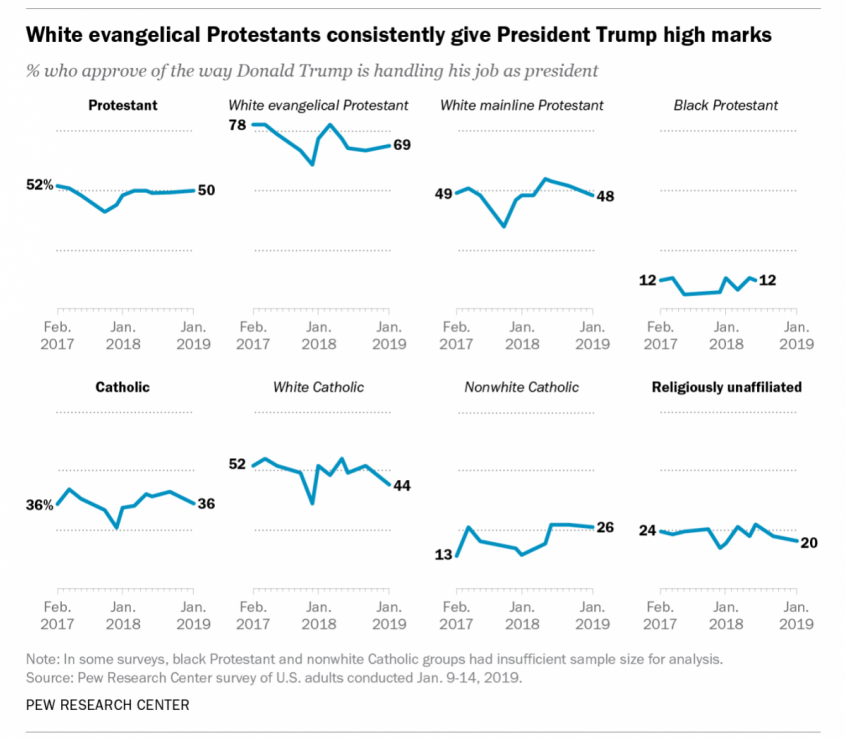
But among some faith demographics, President Trump appears to have made inroads, with support among non-white Catholics doubling from 13 per cent in February 2017 to 26 per cent in February 2019. Overall Catholic support for the president remained at 36 per cent during the same period.
"White evangelicals' support for the president has been consistently high, and many prominent evangelical leaders, such as Jerry Falwell Jr. – the president of Liberty University – have steadfastly stood with the president," said Pew.
But the research group added that the generally high approval ratings among white evangelical Protestants does not mean that they don't have any reservations about him, as confirmed by an August 2018 survey which found that around half did not think he had set a high moral standard for the presidency since taking office.
"Some prominent evangelical leaders, such as Rick Warren, pastor of Saddleback Church, have expressed ambivalence about Trump and concern about some of his policies. Others, such as Beth Moore, founder of Living Proof Ministries, openly oppose the president," it said.
While white evangelical Protestant support is consistently high, the opposite can be said for religiously unaffiliated Americans, including atheists and agnostics.
Support for Trump was lowest in this group, having only a 24 per cent approval rating of the president in February 2017 and a 20 per cent approval rating by February 2019.
"Religiously unaffiliated Americans consistently express among the lowest levels of approval of Trump's performance, ranging from 17% to 27% across the polls the Center has conducted since the president assumed office," added Pew.
A separate poll by Morning Consult poll last week was further evidence of the reservations held by some Christians over Trump's behaviour. The survey asked 2,201 adults whether Trump had been right to sign Bibles during a visit to victims of the tornadoes in Alabama.
White evangelicals were more likely to find it "inappropriate" (45 per cent) as opposed to "appropriate" (35 per cent), but taking all Christian respondents into consideration, 65 per cent believed it to be "inappropriate" while only a quarter (24 per cent) said it was "appropriate".