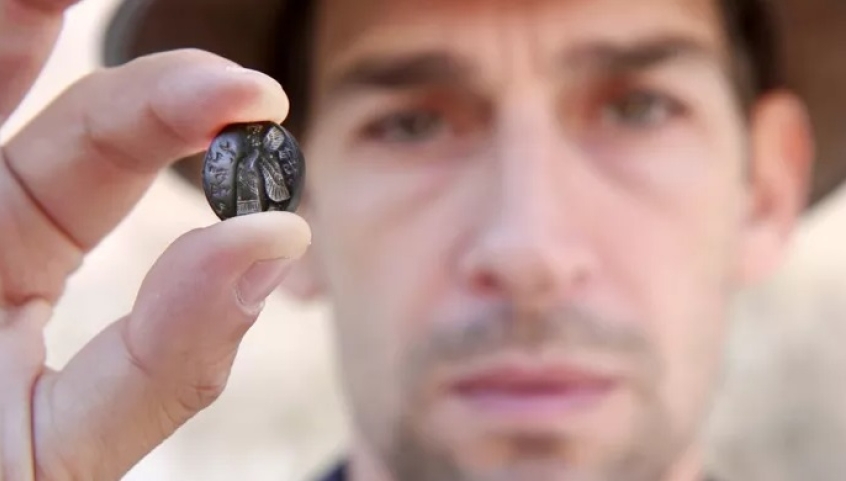
(CP) Archaeologists in Israel uncovered a stone seal they believe to be around 2,700 years old from the First Temple period, a find that strengthens the biblical heritage of Jerusalem.
The seal, discovered at the City of David National Park in Jerusalem, contains a winged figure with one arm raised forward with an open palm, the Israeli Antiquities Authority announced.
The seal was discovered during excavations conducted by the Israel Antiquities Authority and the City of David Foundation near the Southern Wall of the Temple Mount in the Davidson Archaeological Garden.
On either side of the figure is an inscription in paleo-Hebrew script that reads "LeYehoʼezer ben Hoshʼayahu."
The figure appears to be designed in the Neo-Assyrian Empire style, which makes the excavation team believe shows the influence of the empire in the region dating as far back as the ninth century B.C.
Yuval Baruch and Navot Rom, excavation directors for the Israel Antiquities Authority, described the seal of black stone as "one of the most beautiful ever discovered in excavations in ancient Jerusalem," adding that the stone is "executed at the highest artistic level."
"The figure of a winged man in a distinct Neo-Assyrian style is unique and very rare in the glyphic styles of the late First Temple period," Baruch said. "The influence of the Assyrian Empire, which had conquered the entire region, is clearly evident here."
According to Baruch, the finding contradicts assumptions that only elite members of society were literate. The piece seems to suggest that more people knew how to read and write at a basic level, at least for commerce needs.
Further descriptions of the finding state, "The name Yehoʼezer is familiar to us from the Bible (Chron. I 12:7) in its abbreviated form — Yoʼezer, one of King David's fighters," while also stating that "in the book of Jeremiah (43:2), describing the events of this very period, a person is mentioned with a parallel name, ʼAzariah ben Hoshʼaya."
"The two parts of his first name are written in reverse order to the seal owner's name, and his second name is the same, appearing in its abbreviated form. This writing form in the text fits the name on the newly discovered seal and it is thus appropriate for this time period."
Ze'ev Orenstein, director of International Affairs for the City of David Foundation, told Fox News that the seal "joins the list of countless archeological discoveries in the City of David — the historic site of Biblical Jerusalem — affirming Jerusalem's Biblical heritage."
"It similarly serves as yet another affirmation of the thousands-of-year-old bond rooting the Jewish people in Jerusalem — not simply as a matter of faith, but as a matter of fact," he said.
Earlier this month, the Israel Antiquities Authority shared the details of another excavation in Jerusalem, this time of the drainage channel from the Second Temple Period. The finding provided further insight into the city before the temple's destruction in 70 A.D.
"Into the channel's mouth were swept the detritus of the life above Jerusalem's main street; where they remained preserved between the walls just as they were at the moment of the city's destruction," Excavation Director Ayala Zilberstein stated.
"Small finds tell us a big story, from Jerusalem's heyday of prosperity and splendor when its streets bustled with life, until the city's ebbing moments during the rebellion against the Romans, and its total abandonment following the Temple and city's destruction."
"Since most of these municipal channels were maintained and cleared regularly, to find layers of silt in the main drainage channel filling it to almost half its height, indicates a gradual neglect of city maintenance," Zilberstein added. "And indeed, this very neglect and abandonment that we are now witness to here corresponds to the story of the process of Jerusalem's destruction."