Hamas and Israel are continuing to trade fire, killing two more Palestinians and injuring more than two dozen others in the latest attack.
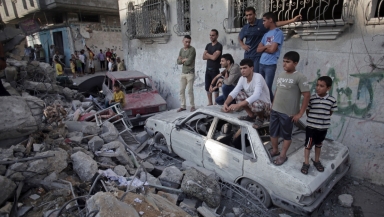
A 15-storey building, home to 70 families as well as several offices, collapsed during Israeli airstrikes into Gaza this morning, forcing hundreds to evacuate. A second high-rise building was also severely damaged.
No one was killed in the attack, but 25 were injured. Two casualties have been reported from an air strike on a house, however.
The Associated Press (AP) reports that Israel has not explained this change in tactic – now entirely destroying large civilian structures rather than pinpointing suspected Hamas targets within them – though a military spokesperson has confirmed that the latest strikes were "a direct result to Hamas' decision to situate their terrorist infrastructure within the civilian sphere including schools, hospitals and high-rise buildings."
"We are determined to restore security to the State of Israel, and are unprepared to enable Hamas to continue to kill Israelis, target our towns and cities and expect to operate without consequence to their facilities, militant operatives and the leadership of their heinous attacks against Israel," Col. Peter Lerner added in an email to AP.
There is speculation that the Israeli military is attempting to pressurise Hamas through targeting the middle-classes.
More than 2,100 Palestinians – almost all civilians, including almost 500 children – have been killed since Israeli airstrikes began on July 8 under the title 'Operation Protective Edge'.
Sixty-eight Israelis have also been killed. The violence has destroyed more than 17,000 Palestinian homes and 80% of Gaza has been cut off from electricity.
Humanitarian agencies report that there is just one litre of water a day per person in the Palestinian city, which falls far below UN emergency standards and it is now widely considered a full-blown humanitarian crisis.
Gazans have begun filming themselves pouring rubble over their heads – a twist on the ALS Ice Bucket Challenge sweeping across the internet – in an attempt to draw attention to their plight.
"I have to do something and to send a message all over the world about Gaza," explained Ayman al Aloul, a Palestinian journalist, who was the first to begin the Rubble Bucket Challenge.
"We do not have water but this is what we have. Perhaps I will not find water to wash up with when I get home."