A vicar's attempt to solve the mystery surrounding William Shakespeare's skull has been blocked by a senior church lawyer, The Telegraph reports.
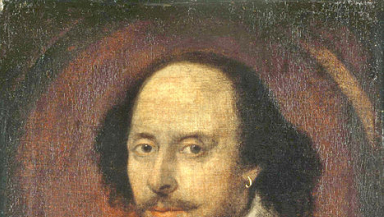
According to legend, a skull found in a Worcestershire church vault belonged to the playwright after it was robbed from his grave to win a £300 bet. However a clergyman's attempt to test the legend has been defeated by a church lawyer.
Rev Paul Irving applied for permission from the Church of England's Consistory Court to remove the skull for DNA testing. Although the application was supported by other local clergy, it was thrown out by the chancellor of the diocese of Worcester. Charles Mynors ruled that there was nothing to link the skull to Shakespeare.
There was "no scholarly or other evidence that comes anywhere near providing any support for the truth of the story" and that there was "nothing whatsoever to link it to William Shakespeare," said Mynors.
The barrister sided with prominent Shakespearean scholars who have also rubbished the claims as "a piece of Gothic fiction."
"The curiosity as to the skull at Beoley has no factual base whatsoever to justify exhumation, removal or investigation," concluded Mynors' 7,000 word judgement.
However the team rector at Holy Trinity Redditch which oversees the parish of Beoley said he was disappointed by the ruling adding there was "absolutely no way we can disprove" the theory.
"There is this skull sitting there on its own and we would love to know who it is," Richard Clark told the Telegraph. "The ideal for us would have been to get some DNA testing to try to match it up to see if it's part of one of the skeletons that's down there or who or what it might be."
"While I understand we don't want people on fishing expeditions mucking about with human remains, the problem for us now is that the failure to conduct a detailed investigation will result in a higher level of uninformed speculation - whereas if we had the investigation done, then it would settle the matter once and for all."
The legend is founded on two magazine articles, the first of which claimed that a Dr Frank Chambers broke into Shakespeare's tomb and stole the skull in response to an offer from an art historian, Horace Walpole. Walpole refused to hand over the money so Chambers arranged for it to be returned to the tomb which bears an epitaph cursing anyone who attempted to remove his bones.
However a second article claimed this didn't happen and traced the skull to the church in Beoley, 15 miles from Shakespeare's grave in Stratford. Althought the author of the two articles are unknown, it is thought it may have been Rev CJ Langston, vicar of Beoley from 1881 to 1889.