The Bishop of Peterborough has called on the Church to "finish what Jesus started" by working towards the complete eradication of leprosy worldwide.
Bishop Donald Allister was in the slum areas of Dhaka, Bangladesh, last week to see the work of the Leprosy Mission in tackling what is thought to be the world's oldest disease.
Despite its strong association with biblical times, around 10 million people today live with leprosy-related disabilities, including blindness.
The Leprosy Mission England and Wales said that poor sanitation, overcrowding and malnutrition in the slum areas of Dhaka had caused many residents there to have weakened immune systems.
Last month, the President of Bangladesh, Sheikh Hasina, said that the country was determined to defeat the disease by 2030.
During his visit, Bishop Allister sought to encourage interdenominational church leaders in Bangladesh to play their part in meeting this "ambitious" target.
"Christians must step out of the comfort of their churches, into the community, and work with the most marginalised," he said.
"There are some things Jesus did that we are simply not able to do. However, reaching out to people affected by leprosy is something we can do, something that the church should do. We want to finish what Jesus started by curing leprosy and ending needless suffering."
Latest statistics from the World Health Organisation show that there were 3,729 new cases of leprosy diagnosed and treated in Bangladesh in 2018, but organisations in the country working to eradicate the disease believe the real rate is far higher.
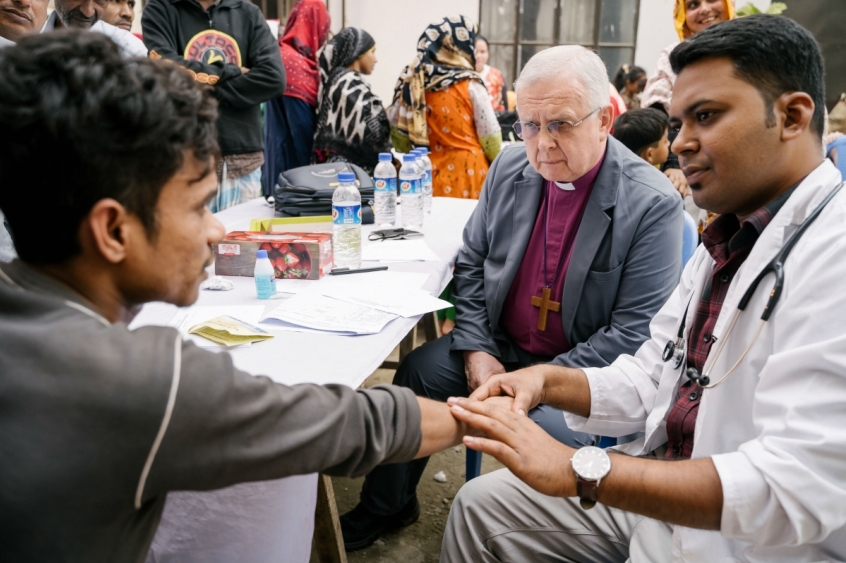
Peter Waddup, National Director of the Leprosy Mission England and Wales, accompanied the bishop on his visit to Bangladesh, which included meeting patients at a 'skin camp' in the courtyard of a Dhaka church run by the Leprosy Mission.
The Leprosy Mission said that calling the pop-up clinic a 'skin camp' encourages people to attend who fear that they might have leprosy but are too afraid to seek treatment.
Mr Waddup said: "It was heartwarming to see hundreds of people stream into the church courtyard."
He continued: "When a person is diagnosed with leprosy, our programme reaches out to the community from which they belong and raises awareness about the disease.
"As well as extended house to house screening programmes in 40 of the neighbouring households, we run skin camps where people from the wider community can come to be treated for skin conditions.
"These camps provide a great opportunity to identify and treat new cases of leprosy that might otherwise have been missed.
"We need churches to join the mission – churches from Bangladesh to work with communities of all faiths on the ground to raise awareness about leprosy and to signpost people to treatment where needed."
Bishop Allister, who is Vice-President of the Peterborough-based Leprosy Mission England and Wales, reflected: "Life in these poverty-stricken communities in the Bangladeshi capital is extremely hard, without having to bear the emotional and physical impact of leprosy.
"It has been a privilege to witness compassion and healing, to see doctors reaching out just as Jesus did.
"Nothing will erase what I have experienced today. I'm encouraged that church leaders have been extremely receptive to taking on board the mission to end leprosy in Bangladesh.
"Working at the grassroots is the only way to tackle the stigma that prevents people coming forward for treatment. I pray that the church at home and in leprosy endemic countries will take action and unite to end this ancient disease"