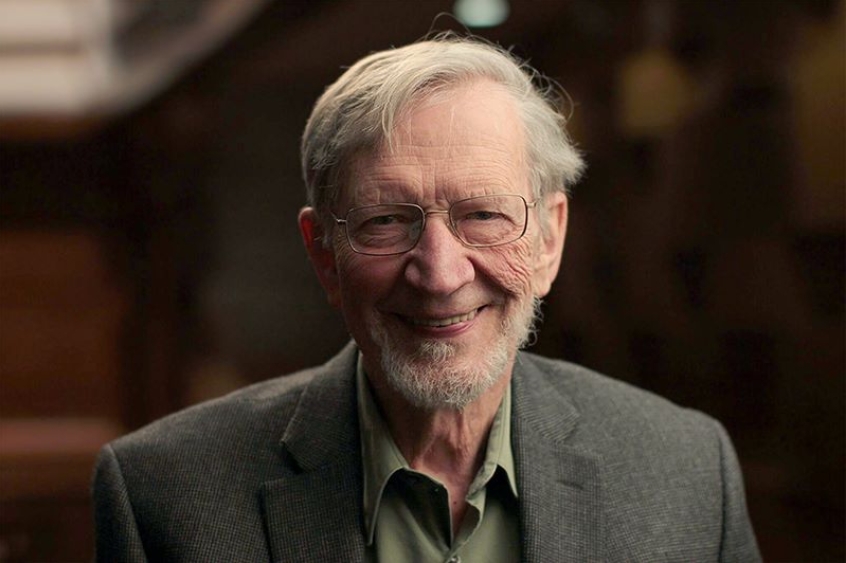
A prominent American Christian philosopher scholar who made belief in God in a serious option within academic philosophy has been awarded the prestigious £1.1 million Templeton Prize.
Alvin Plantinga, a giant of philosophy and apologetics over the past 50 years, was announced as the 2017 Templeton Prize Laureate yesterday.
'Sometimes ideas come along that revolutionise the way we think, and those who create such breakthrough discoveries are the people we honour with the Templeton Prize,' said Heather Templeton Dill, president of the John Templeton Foundation, which awards the Prize.
'Alvin Plantinga recognised that not only did religious belief not conflict with serious philosophical work, but that it could make crucial contributions to addressing perennial problems in philosophy.'
Plantinga, now retired at 84, said: 'I am honoured to receive the Templeton Prize. The field of philosophy has transformed over the course of my career. If my work played a role in this transformation, I would be very pleased.
'I hope the news of the Prize will encourage young philosophers, especially those who bring Christian and theistic perspectives to bear on their work, towards greater creativity, integrity, and boldness.'
The Templeton Prize honours those who have 'made an exceptional contribution to affirming life's spiritual dimension, whether through insight, discovery or practical works'. It was established in 1972 by the investor and philanthropist John Templeton, who wanted to credit those responsible for what he called 'marvellous new things going on in religion'.
Valued at £1.1 million, the prize is one of the world's largest awards granted to an individual.
A philosopher who nominated Plantinga for the prize explained the philosopher's legacy: 'Alvin Plantinga's intellectual discoveries have initiated novel inquiry into spiritual dimensions. His precise and carefully developed insights have opened up intellectual-spiritual space.
'In the 1950s there was not a single published defence of religious belief by a prominent philosopher; by the 1990s there were literally hundreds of books and articles... defending and developing the spiritual dimension. The difference between 1950 and 1990 is, quite simply, Alvin Plantinga.'
As a philosophy professor at Calvin College and the University of Notre Dame, and a lecturer at Oxford, Harvard and several other institutions, Plantinga's Christian influence on mainstream philosophy has long been celebrated within the Church.
He arguably settled the logical problem of evil, one of the most commonly asserted objections to Christian belief, in his landmark book God, Freedom and Evil in 1974. He has also made major contributions emphasising the compatibility of science and religious belief, and opened the door for religious, theistic convictions in the realms of reason and philosophy, where 'God' was previously thought unwelcome.
Here are seven quotes from the philosopher that give a glimpse of his legacy of thought.
1. 'Faith is not to be contrasted with knowledge: faith (at least in paradigmatic instances) is knowledge, knowledge of a certain special kind.'
2. 'There is superficial conflict but deep concord between science and theistic religion, but superficial concord and deep conflict between science and naturalism.'
3. 'Is it a fact that those who believe in a Heavenly Father do so because or partly because their earthly fathers were inadequate? I doubt it. If it is a fact, however, it is of psychological rather than theological interest. It may help us understand theists, but it tells us nothing at all about the truth of their belief; to that it is simply irrelevant.'
4. 'Suppose we concede that if I had been born of Muslim parents in Morocco rather than Christian parents in Michigan, my beliefs would be quite different. [But] the same goes for the pluralist...If the pluralist had been born in [Morocco] he probably wouldn't be a pluralist. Does it follow that...his pluralist beliefs are produced in him by an unreliable belief-producing process?'
5. 'But lack of evidence, if indeed evidence is lacking, is no grounds for atheism. No one thinks there is good evidence for the proposition that there are an even number of stars; but also, no one thinks the right conclusion to draw is that there are an uneven number of stars. The right conclusion would instead be agnosticism.'
6. 'If we don't know that there is such a person as God, we don't know the first thing (the most important thing) about ourselves, each other and our world. This is because the most important truths about us and them, is that we have been created by the Lord, and utterly depend upon him for our continued existence.'
7. 'In religious belief as elsewhere, we must take our chances, recognising that we could be wrong, dreadfully wrong. There are no guarantees; the religious life is a venture; foolish and debilitating error is a permanent possibility. (If we can be wrong, however, we can also be right.)'