Too many children in the UK are trapped in poverty with no hope of change, a Church of England bishop says today.
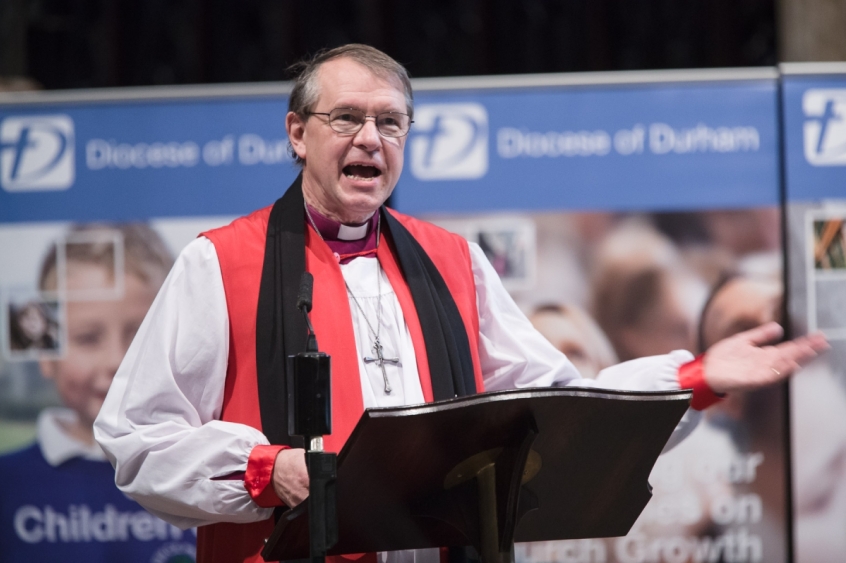
Bishop of Durham Paul Butler called on the government to put ending child poverty at the top of its agenda.
Referring to a report from the Social Mobility Commission that shows failure to narrow the gap between the rich and poor, he said, 'This report highlights the need for all of us to refocus our efforts on ensuring that every child is able to reach their full potential regardless of their background.'
'While there have been some positive changes over the last two decades, too many children are still being held back through no fault of their own.
'Most worrying is the conclusion that child poverty has been deprioritised in recent years and that there is currently no prospect of ending child poverty in the foreseeable future. We simply must not allow child poverty to be side-lined in this parliament.'
The report follows years of austerity measures by government and outlines how social mobility has stalled in the last two decades.
It warns that without deep-seated reform, social and economic divisions in British society are set to widen with consequences for community cohesion and economic prosperity.
The report gives 'red', 'amber' and 'green' ratings for how well governments have done in helping people overcome poverty at different stages of their lives.
Damningly, it cannot give a 'green' rating to any of the life stages. Both early years and schools are given an 'amber' rating, while young people and working lives receives a 'red'.
Overall, only 7 policies score a green while 14 score 'amber' and 16 'red'.
While the report says that some policies – such as increasing employment and getting more working-class young people into university – have had a positive impact, overall the report concludes that 'too little' has been done to break the link between socio-economic background and social progress.
It says that over 20 years new divides have opened up in Britain, across geographies, income groups and generations – and that many policies of the past are no longer 'fit for purpose'.
Former Labour MP Alan Milburn, chair of commission, said, 'As the general election seems to demonstrate, the public mood is sour and whole tracts of Britain feel left behind. There is a mood for change in Britain.
'When more and more people feel like they are losing out, social mobility matters more than ever before. Higher social mobility can be a rallying point to prove that modern capitalist economies like our own are capable of creating better, fairer and more inclusive societies. It is the best antidote to the growth of political populism, both right and left, that we have witnessed around the world.
'For two decades, successive governments have made the pursuit of higher levels of social mobility one of the holy grails of public policy. While there has been some progress, it has not gone far enough towards translating welcome political sentiments into positive social outcomes.
'In fact, what is so striking about this new analysis is how divided we have become as a nation. A new geographical divide has open opened up, a new income divide has opened up and a new generational divide has opened up.
'If we go on like this, these divisions are set to widen, not narrow. There is a growing sense in the nation that these divisions are not sustainable, socially, economically or politically. There is hunger for change. The policies of the past have brought some progress, but many are no longer fit for purpose in our changing world. New approaches are needed if Britain is to become a fairer and more equal country.'