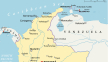
A Catholic priest has been quarantined after infection by the Ebola virus in the river port city of Mbandaka, in the Democratic Republic of Congo (DRC).
An anonymous source told AFP yesterday: 'We have quarantined a priest from the diocese of Mbandaka-Bikoro who tested positive'.
The DRC's ninth recorded outbreak of the disease is thought to have killed at least 22 people so far, according to government figures released on Wednesday. A previous count put the toll at 27, though several of those deaths are now believed not to be related to Ebola.
DRC health officials have launched a targeted vaccination effort this week in a bid to restrain the Ebola outbreak: 58 cases have been identified since early April, while last Thursday saw the first reported incident in a city, in Mbandaka.
Ebola is a deadly, highly infectious virus that spreads through bodily fluids including vomit and sweat.
Yesterday it was revealed that two dying Ebola patients had been taken from a Congo hospital by their relatives on motor-bikes, then taken to a prayer meeting with 50 other people, potentially exposing all to the deadly virus.
Both patients were vomiting and infectious and died hours after the prayer session in Mbandaka, Dr Jean-Clement Cabrol, emergency medical coordinator for Medecins Sans Frontieres (Doctors Without Borders), said.
'The escape was organised by the families, with six motorcycles as the patients were very ill and couldn't walk,' Cabrol said.
'They were taken to a prayer room with 50 people to pray. They were found at two in the morning, one of them dead and one was dying. So that's 50-60 contacts right there. The patients were in the active phase of the disease, vomiting.'
'All it takes is one sick person to travel down the Congo River and we can have outbreaks seeded in many different locations...that can happen at any moment, it's very hard to predict,' Dr Peter Salama, head of emergency response at the WHO told Reuters.
'It is going to be at least weeks and more likely months before we get this outbreak fully under control.'
The WHO's three-month budget for the crisis has already been doubled to $57 million.
There have been major advances in medical treatment of the virus since it ravaged West Africa in 2014-2016, including an experimental vaccine that can protect medical staff.
However, local scepticism about the dangers of Ebola and the need to isolate infection continues to complicate efforts to contain it. In previous outbreaks, mourning relatives have caught the haemorrhagic disease by laying hands on the highly-contagious bodies of dead loved ones.
Additional reporting by Reuters