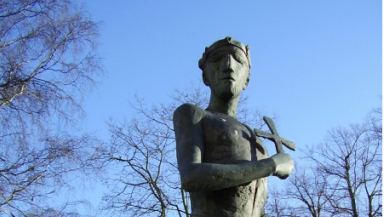
Town councillors have given their backing for an excavation that could uncover the bones of one of England's early kings and martyrs, slain by his enemies centuries ago.
Hang on, I know this one! It was Richard III.
St Edmund.
He was buried under a car park.
A tennis court.
It was in Leicester, or York.
Bury St Edmunds.
I thought he'd already been dug up, anyway?
I think your problem is that are rather a lot of deceased kings, and they do turn up from time to time. Richard III's body was indeed found under a car park in Leicester in 2012. But archaeologists think St Edmund's body might lie under a tennis court in the town named after him, Bury St Edmunds in Suffolk.
Shouldn't that be 'Buried St Edmunds'?
Please don't be facetious. 'Bury' is from an Anglo-Saxon word, 'burh', meaning a fort or fortified place.
Sorry. Was Edmund a king, then? I thought you said he was a saint.
It's rather rare, but you can be both. He was in fact a king in a small way, of East Anglia, and lived during the heroic Anglo-Saxon period when the English were valiantly resisting the Vikings who ravaged the country with fire and sword. He appears in the Anglo-Saxon Chronicle, which says he reigned from about AD 855 until his death on November 20, AD 869.
What was so saintly about him, then?
The manner of his death. He was defeated by the Vikings under the fearsome Ivar the Boneless and his brother Ubba. They demanded he renounce his faith in Christ or be executed; he refused, whereupon he was beaten, shot with arrows ('like the bristles of a hedgehog') and beheaded.
That's awful. So archaeologists are looking for a headless corpse?
By no means. His head was thrown into the forest, but searchers followed the cries of a ghostly – and well-educated – wolf, who called out 'Hic, hic, hic' – 'Here', in Latin. They found the head and reunited it with the body, and it was buried at Bury. A magnificent shrine and abbey grew up which was destroyed when Henry VIII dissolved the monasteries.
And the tennis court?
Built over a monks' graveyard. Edmund was buried, unusually, in an iron coffin; if they can find one, they can be pretty sure it's him.
I have to say I'm a bit dubious about the story of the wolf.
To borrow a phrase used by the historian JA Froude of a different saint: 'This is all, and perhaps rather more than all, that is known of the Blessed St Edmund.'
Follow Mark Woods on Twitter: @RevMarkWoods