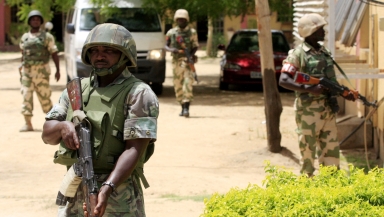
The US State Department appeared reluctant to acknowledge the Christian focus of Boko Haram's attacks across Nigeria in a recent exchange with political leaders.
State Department undersecretary Sarah Sewall was asked by Rep Jeff Duncan in a recent House Foreign Affairs Committee hearing whether the militant Islamist group specifically targeted Christians.
In reply, Sewall said Boko Haram was attacking "everyone who is Nigerian" and represents an "equal opportunity threat for all Nigerian citizens".
"I wish there was such discrimination in Boko Haram attacks," she said.
Representatives at the hearing were not content with her answer, however, and Rep Chris Smith asserted in response that Boko Haram was primarily targeting Christians.
As evidence of this, he told the hearing that the group had attacked 100 Christian churches in Nigeria from 2012 to 2013. By comparison, only four mosques were attacked by Boko Haram in the same period.
"Yes, they'll hit other Nigerians, they'll hit other westerners, but Christians are their main target," said Smith.
After sharing about one Christian man who was survived a gunshot to the face after refusing to recant his faith before the militants, Smith contended: "That is the underlying, fundamental, raison d'être of Boko Haram."
If the question was whether Boko Haram and their actions "target Christianity", Sewall replied, then the answer is "absolutely, unequivocally".
However, she continued: "More fundamentally, they target other things too and they are a threat to the government and the region.
"And so I loved the very clear-eyed characterisation that was just offered [by Rep Steve Stockman], which is that Boko Haram is motivated by hatred. I don't think anybody would disagree with that."
The question of whether the media is playing down the anti-Christian aspect of the violence was raised earlier in the month by Robin Harris, a former advisor to Margaret Thatcher.
He raised concerns in a blog for the Spectator entitled 'The kidnapped Nigerian girls are Christian. Why doesn't our media say so?'.
In the piece, Harris points out that the US and UK authorities have both shied away from mentioning that nearly all the girls abducted by Boko Haram from a school last month are Christian.
He argues that it is their Christianity that "caused them to be victims" and that the Christian enclave of Chibok in Borno State, where the school was located, is now the scene of "systematic Islamist persecution and intimidation".
"Full, credible, detailed accounts are available through the Christian online networks," Harris writes.
"Yet commentators still seem content to exercise self-censorship. The religious identity of the girls has not been mentioned in the mainstream US or British media.
"The words 'poverty', 'corruption', and 'incompetence' figure largely, and with some justice, in explanations of what is dysfunctional in Nigeria. But the word "Christian' is notable by its absence in explaining what happened in Chibok.
"Nigeria is, in truth, the scene of a brutal religious war being fought by jihadists against Christians. But don't expect the White House or Downing Street, let alone Foggy Bottom or the FCO, to own up to it."