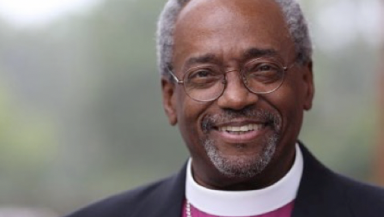
The Episcopal Church's Presiding Bishop Michael Curry was hospitalised in Raleigh, North Carolina, on Sunday due to a subdural hematoma, known as a brain bleed, provoked by a fall he took earlier in the weekend in Syracuse, New York. The bishop is now recovering from his surgery at Raleigh's hospital, where he resides.
The Episcopal Church's public affairs office released a statement asking for prayers "for Bishop Curry, his family, and his medical team."
On Saturday, Curry had attended a celebration of the Diocese of Central New York at Grace Church in Utica, near Syracuse. The bishop kicked off the event with a welcome speech alongside the Rt. Rev. DeDe Duncan-Probe, the bishop of Central New York, and Grace Church's rector, the Rev. Christine Williams-Belt, before preaching during a festive Eucharist in the afternoon.
Curry, who is 70, is in the last year of his nine-year term as the 27th presiding bishop and primate of the Episcopal Church. The bishop has been hospitalised two other times this year for internal bleeding and heart conditions.
On Memorial Day weekend, Curry was hospitalised to get to the bottom of his recurring irregular heartbeat problem. The bishop was later declared stable and he received treatments for his rapid heartbeat, said the Episcopal Church's public affairs office.
The bishop was in the hospital for an extended stay beginning in August for internal bleeding. On Sept. 20, surgeons removed his right adrenal gland and a noncancerous attached mass that was identified as the cause of the reoccurrence of the bishop's internal bleeding, according to the Episcopal Church's public affairs office.
The bishop left the hospital two weeks later after his medical team had cleared a minor infection.
Since he returned home on Oct. 5, Curry has resumed his travels, although his schedule has been reduced.
This is Curry's second episode with subdural hematoma. In December 2015, a month into his tenure, he was hospitalised because of a brain bleed after a fall that happened on his first day in office. The brain bleed was only identified after he experienced memory loss while preaching at Bruton Parish in Williamsburg, Virginia. His recovery therapy included speech therapy sessions.
"I couldn't remember anything — everything was gone — but, being a preacher, I kept talking," the bishop said in an interview with Episcopal News Service at the time.
Symptoms of a subdural hematoma often can appear a while after the initial head injury, such as a fall. Symptoms include balance issues, confusion and speech problems.
Curry's term ends in November 2024. The Episcopal Church's Joint Nominating Committee for the Election of the Presiding Bishop is already seeking potential candidates for his successor. The next presiding bishop will be elected in June at the 81st General Convention in Louisville, Kentucky.
The Episcopal Church is part of the worldwide Anglican Communion.
© Religion News Service