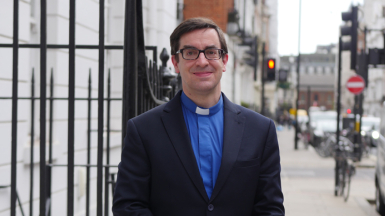
An employment tribunal is to hear the case of a former school chaplain who says he was blacklisted from officiating in the Church of England after giving a sermon on identity politics.
Bernard Randall will tell the tribunal, taking place on Thursday and Friday, that he has been unemployable as a Church of England priest after the Bishop of Derby, Libby Lane, allegedly refused to allow him to work as a minister following his dismissal from Trent College in Nottingham.
The college sacked Randall and reported him to Prevent, the government's anti-terrorism scheme, over a 2019 sermon in which he told students that it was ok to question ideological LGBT teaching.
He says that the diocese failed to defend him and instead blacklisted him as a "safeguarding risk" to children.
He also claims that the diocese has never specified what the allegations against him were or shown evidence of wrongdoing.
A diocesan safeguarding risk assessment is reported to have concluded that Dr Randall posed a "reputational risk" to the Church of England and that the Church could be "a risk factor to itself" because of its historic stance on marriage and human identity.
A preliminary hearing at the East Midlands Employment Tribunal this week will decide whether the actions of the Bishop of Derby fall within the remit of an employment tribunal.
Speaking ahead of the hearing, Dr Randall said he had been deeply hurt by the Church of England.
"I'm being charged with wrongthink," he said.
"There is no allegation that my behaviour towards any person has ever fallen below proper standards. Only my thinking is being checked. Even the Spanish Inquisition told people what the charges were.
"People in the Church are accusing me of the crime of thinking what the Church thinks; because I preached what the Church teaches, they think I am too dangerous to be allowed to preach in any Church.
"The Bishop of Derby has shown moral cowardice in refusing to stand up for the goodness of the Church's own teaching, and totally failed to support and vindicate me. Sadly, the C of E seems to care more about its reputation in the secular world than showing spiritual leadership."
Andrea Williams, chief executive of the Christian Legal Centre, which is backing Dr Randall's case, said: "Bernard is one of many faithful Church of England ministers who have been targeted for believing and defending the Christian views on sexuality, gender and marriage.
"On paper, the Church of England believes and teaches exactly what Bernard said. But in practice, ministers like him are put through cruel safeguarding procedures as if believing the church's own doctrine makes him a danger. The bishop failed in any way to stand up for Bernard and is effectively seeking to end his ordained ministry.
"The further the Church of England goes in muddling and abandoning its own teaching, the more people like Bernard will be forced out through these tortuous and unreasonable processes.
"We will stand with Bernard and all others who continue to live and speak out the Christian faith in public life for as long as it takes."
The Diocese of Derby has been contacted for comment.