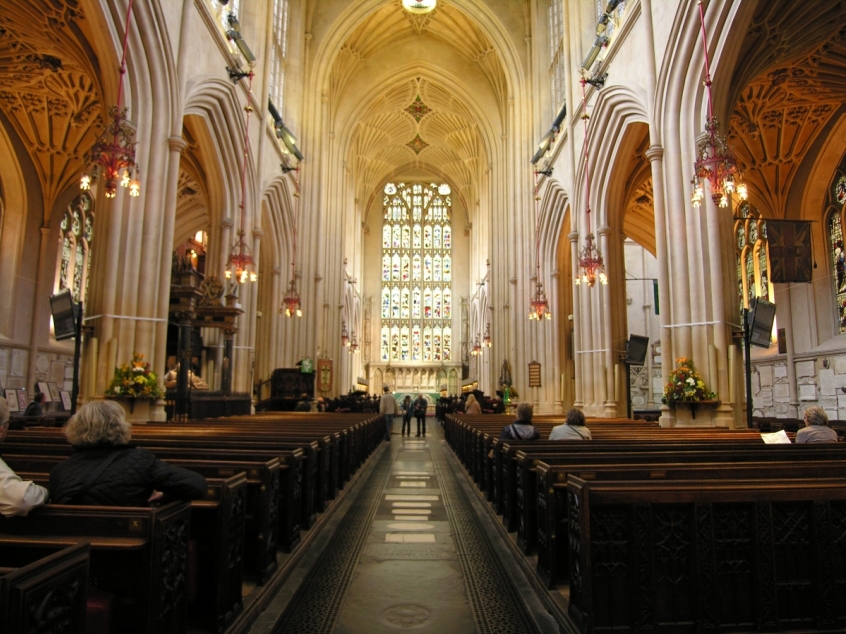
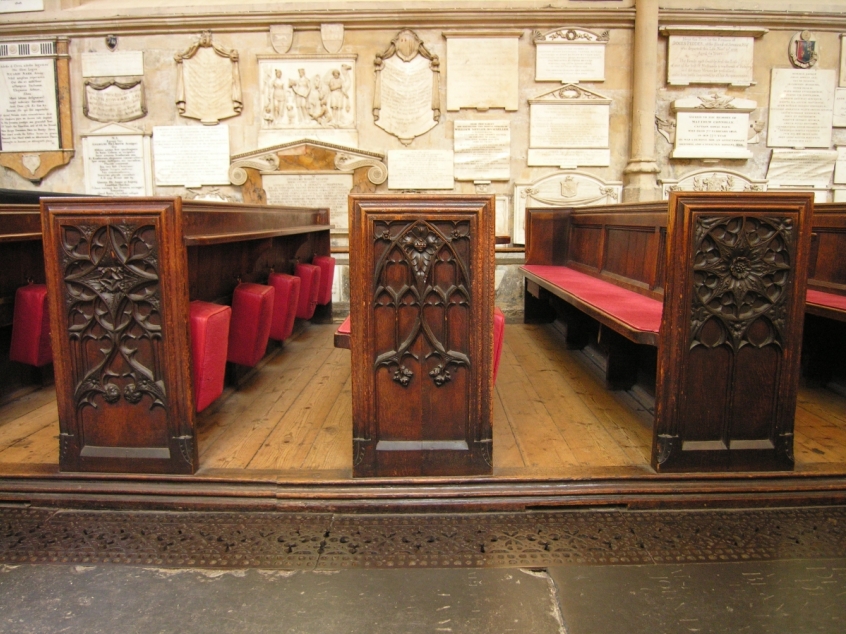
A church court has ruled that officials at the Grade 1 listed Bath Abbey can remove its historic Victorian pews on the grounds that more people could be attracted for popular events such as concerts and bake sales.
Heritage campaigners from the Victorian Society, which challenged the move to replace the pews with stackable wooden chairs, have expressed their disappointment and argued that the pews are vital to the character of one of Britain's most historic buildings.
But the move was approved at a consistory court meeting yesterday.
The rows of fixed pews were installed when the former Benedictine monastery was renovated by Sir George Gilbert Scott in the 1860s.
Officials at the Abbey applied for permission from the Church of England for the 'uncomfortable' seating to be removed before a planned multi-million pound renovation.
At a court session in October, Rev Edward Mason said the Abbey was 'facing crisis' with an ageing congregation and a decline in visitors, and argued that the Abbey needed to be modernised with floor space freed up to make room for popular events. 'Christians all over the city want to come here to worship in a way they want to,' he said. 'Removing the pews would be making the church fit for the 21st century. If we want this church to be able to grow to the people that come into it that's what we need to reflect.'
Mason pointed out that until 1860 the abbey would have been completely open-plan and argued it was again time to update the building.
But Mason's plan, called the 'Footprint' project, was branded a 'pipe dream' by the barrister Mark Blackett-Ord QC, who represented The Victorian Society, which said removing the pews would cause 'serious harm' to the building.
The Director of the Victorian Society, Christopher Costelloe, said: 'Obviously we are disappointed with the...decision. The loss of the Victorian nave furnishings would permanently diminish the interest of the Abbey. We will now give careful consideration to appealing against the judgment.'
James Hughes, churches conservation adviser for the Victorian Society, who was also present at the court hearing, said: 'We fought our case well but sadly in the end the Chancellor judged in the Abbey's favour. We are grateful for the high level of support we had from members of the public via our online petition; it's always wonderful to see people eager to protect their heritage. We are only sorry the outcome was not what we hoped for in this case.'
The society pointed out that unlike listed secular buildings, Church of England places of worship are exempt from the requirement to obtain listed building consent from local councils to undertake internal or external changes which would normally warrant such consent.
Following a decade of planning, consultation and development, work at Bath Abbey is set to begin in the spring of 2018.
The 'Footprint' project will also see the collapsing floor repaired and underfloor heating installed, powered by energy from Bath's natural hot springs.
Developers believe it could produce 1.5 megawatts of energy, which would be enough to heat the Abbey.
The project will cost £19.4 million, helped by donations and a £10.7 million Heritage Lottery grant.