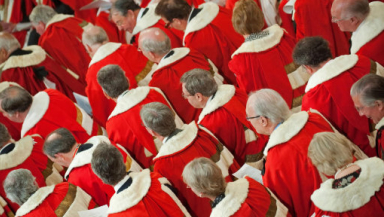
The Archbishop of York spoke out against assisted dying in the House of Lords on Friday.
Dr John Sentamu spoke sympathetically about the difficulties people face in being given a terminal diagnosis, but said any decision on the Assisted Dying Bill could not be based on competing personal stories.
He warned that Lord Falconer's bill could "deprive some terminally ill individuals and their families of "very important time of shared love and wonder" as they savour their final months, weeks and days with each other.
The Archbishop related the experience of the Bishop of Worcester, John Inge's wife, Denise, who passed away from a sarcoma on Easter Day.
She wrote of her final days: "Contemplating mortality is not about being prepared to die, it is about being prepared to live. And that is what I am doing now, more freely and more fully than I have since childhood.
"The cancer has not made life more precious – that would make it seem like something fragile to lock away in the cupboard. No, it has made it more delicious."
Dr Sentamu said assisted dying was "too complex and sensitive" to be rushed through Parliament, and he added his voice to calls for a Royal Commission to be set up to consider the issue further.
He said the bill should not be seen as an assertion of human freedom as he reiterated the Church of England's strong opposition to assisted dying.
While it is possible to think an early death would be welcomed by close family and "spare them the trouble", he said the best thing to do would be to care for the sick and "show appreciation of them at the end of one's life".
"Human freedom is won only by becoming reconciled with the need to die, and by affirming the human relations we have with other people," he said.
"Accepting the approach of death is not the attitude of passivity that we may think it to be. Dying well is the positive achievement of a task that belongs with our humanity. It is unlike all other tasks given to us in life, but it expresses the value we set on life as no other approach to death can do.
"We need time, human presence and sympathy in coming to terms with a terminal prognosis. To put the opportunity to end one's life before a patient facing that task would be to invite him or her to act under their influence rather than dealing with them."
The Church of England's official position on assisted dying is strongly opposed. In 2012, the Church's parliamentary body, the General Synod, passed a motion affirming the "intrinsic value of every human life" and expressing support for the current law "as a means of contributing to a just and compassionate society in which vulnerable people are protected".