"Ashes to ashes, dust to dust/ If the Lord won't have you, the devil must", my dad used to say philosophically. He worked for a funeral director, which gave him a certain perspective on these things.
The saying is a memento mori, "Remember that you must die", and yesterday ashes were everywhere. It was the first day of Lent, Ash Wednesday, when in many Church traditions the foreheads of worshippers are marked with a cross using the ashes of last year's palm crosses mixed with oil or water. 'Ashing' is a sign of deep repentance at the beginning of a period of prayer, fasting and self-discipline.
It's also visual, portable, has a touch of drama about it and so is just perfect for the age of the selfie. Last year it spawned the #ashtag hashtag on Twitter (get it?). This year the hashtag's use peaked at around 3,000 per hour, with users posting pictures of themselves gurning more or less spiritually for the camera.
The Church has also taken the ritual to the streets. In Durham and Chichester, to name but two dioceses, the bishops offered it to passers-by, leading to trails of ashees receiving censorious glances from people who just assumed they hadn't had a wash that morning.
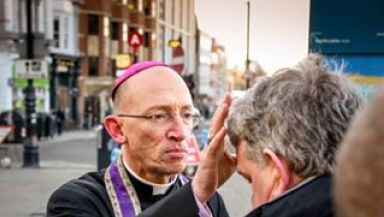
If nothing else, it brings the Church into the market-place. But is it the right rite? Does it actually say more about flawed Christians than it does about the flawless gospel?
I had better come clean and say that I wasn't ashed. I'm a Baptist, and it isn't part of our tradition – far too Popish and ritualistic – so it might be argued that I should keep quiet about my misgivings.
Nevertheless: the fact that I don't do it doesn't mean that I don't understand it. And what worries me is that ashing is an intensely personal and private ritual, in which someone commits to identifying themselves with the suffering and death of Christ. The cross is never a laughing matter. The whole point of a selfie is that it's about the self. The whole point of Ash Wednesday is that it's about Jesus.
And then, those bishops offering public ashings: to whom? Random strangers passing by? People who might go to church for hatches, matches and despatches, but otherwise never darken the door? People who just think it's a bit of a laugh? Is this really an appropriate use of a ceremony which is meant to focus minds intently on the sufferings of Christ?
Again, it might argued: one of the problems with the broadcast offering of the rite is that it evacuates it of meaning. It becomes part of the rich tapestry of the modern multi-cultural streetscape, but not much more than that. I visited India a couple of years ago, for instance, and came out of a Jain temple with a saffron tilak on my forehead. I received it as a courtesy, but it didn't have anything to do with my religion. Am I comfortable with the marks of Ash Wednesday being distributed with similar gay abandon? To be honest, no.
Of course, there's a case for the defence. It can't be a bad thing for bishops to get out on to the streets and meet ordinary people. Theatre is good: it speaks to parts of us that logic can't. Reminding people that the Church is there is good, too: we aren't just a building. Yes, it might make some people think about faith when they wouldn't otherwise. Yes, someone who's been ashed in the morning and wears the cross all day will get some attention, and there's a case for normalising religious practice in an irreligious society (though is it just that we want to compete with people whose faith is more visually expressed, like Sikhs or Muslims, I wonder?). I really do get all that.
But still, I'm uneasy. So let me just, in all humility, counsel those who spent yesterday smudging or smudged: with everything you gain by taking Ash Wednesday to market, think about what you lose, as well.
Follow @RevMarkWoods on Twitter.