In sweltering heat nudging 40 degrees celsius, Justin Welby visited a Christian location with a difference this afternoon – the traditional site of Christ's baptism on the western bank of the River Jordan which is surrounded by thousands of landmines.
The Archbishop of Canterbury was witnessing the work of the Halo Trust of which he is a patron and to which he has donated an undisclosed sum of money as the charity seeks to raise the $1.5 million needed to clear access to the handful of ancient churches and monasteries at the site.
Responsibility for the landmines is disputed, but as a result of conflict in the region, there are 2,600 anti-tank mines as well as anti-personnel mines and booby traps in the churches at the baptism site, known as Qaser al-Yahud in the desert at the Jordan Valley.
Around the time of the Six Day War in 1967, landmines were laid along the border with Jordan and as a result for 50 years access has been denied to the sacred churches at the site.
Halo, of which Prince Harry is the worldwide patron, was established at the end of the Cold War and employs 7,500 people including former fighters from groups such as the Taliban to clear landmines around the world.
It is the world's largest mine clearance organisation, and has been clearing mines in the West Bank since 2014, with the approval of both the Israeli and Palestinian authorities.
Today acted as a reunion between Welby and Major General James Cowan, who met a year ago when Cowan was in the army, to which Welby was making a pastoral visit back in the UK.
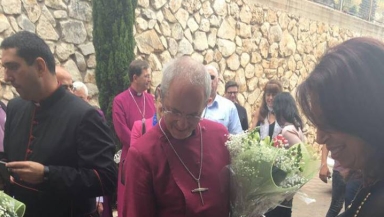
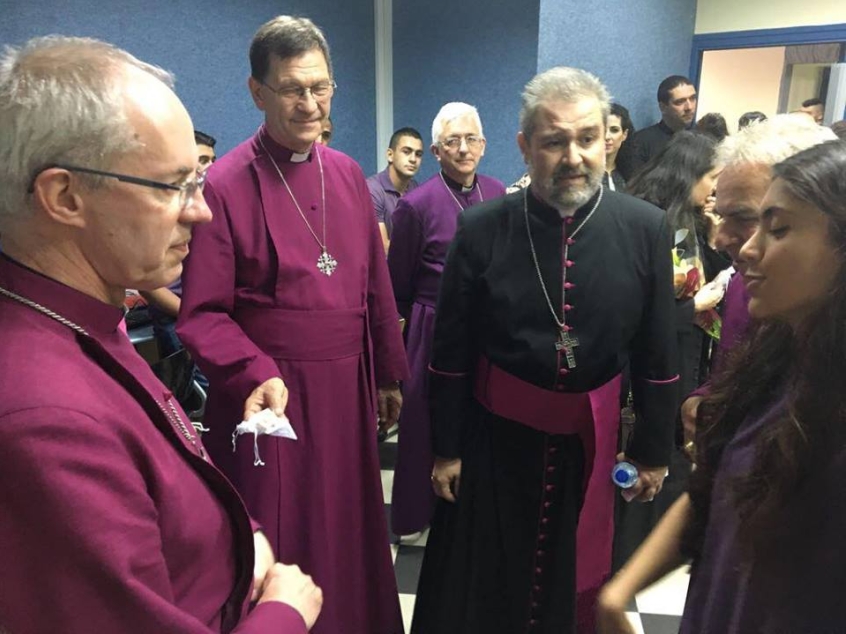
Cowan, who said his work was about 'reconciliation', showed Welby and local church leaders some of the landmines that have been retrieved and disabled, and how they are detected, using modern technology.
'I'm inspired by what Halo is doing as I see them using weapons of war to bring hope of peace,' the Archbishop said, clearly moved. 'My reflection today is there is nothing that God cannot redeem.'
After being briefed on the landmines, Welby, wearing a blue Halo baseball cap, stepped down to the river bank where pilgrims from around the world were singing and taking part in adult baptisms.
The Archbishop gave a blessing to Mother Walatta Selassie from Ethiopia who said she was 'amazed to see the glory of God' in action at the site.
Welby, whose visit came exactly a week after he stopped on the other, Jordanian side of the river during his 12-day tour of the Holy Land, then prayed for the Halo Trust and all its work.
The Trust is hoping to begin work at the site in September, for 5-6 months.
The Catholic Church and seven Eastern Orthodox denominations – Armenian, Coptic, Ethiopian, Greek, Romanian, Syrian and Russian – own churches or land on the minefield.
Despite this, some 300,000 tourists visit the site each year, according to estimates.
In total, more than 3,800 landmines are estimated to be in the ground at the site.