New research into a prayer book owned by Anne Boleyn has offered up fresh insights into the aftermath of her execution.
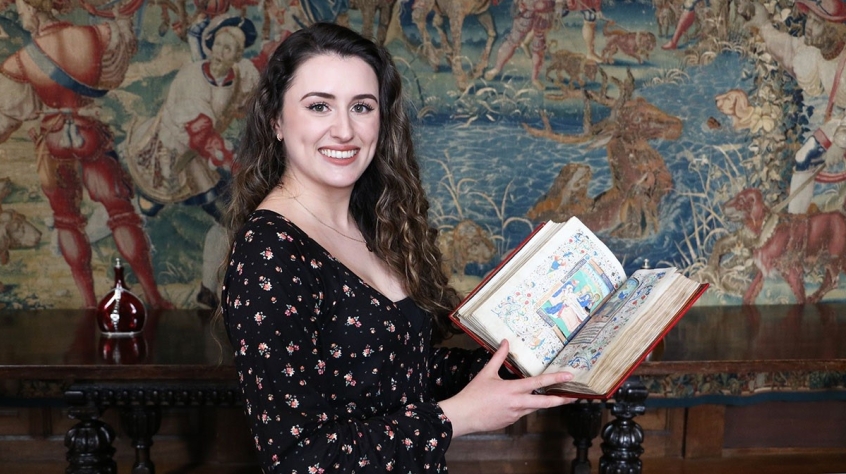
Kate McCaffrey, a former steward at Hever Castle, Boleyn's childhood home, spent nearly a year studying two prayer books owned by Boleyn.
She began her work on the beautifully illustrated books - both on display at Hever Castle - after noticing some intriguing smudge marks.
Legend has it that Boleyn handed the Book of Hours to one of her ladies-in-waiting prior to her execution.
It is remarkable that the books even survived, as many items belonging to the former Queen were destroyed after her demise.
Using ultraviolet light and photo editing software, McCaffrey was able to make out never before seen names and words hidden in the pages of the historic volume.
Prior to this research, it was thought that the prayer books contained only Boleyn's signature and one inscription, "remember me when you do pray, that hope dothe led from day to day."
McCaffrey's research uncovered three family names written in the book - Gage, West and Shirley. All three names centre around a fourth - the Guildford family of Cranbrook in Kent.
She believes the book was passed from female to female in families not only local to the Boleyns at Hever but also connected by kin.
"It is clear that this book was passed between a network of trusted connections, from daughter to mother, from sister to niece," McCaffrey said.
"If the book had fallen into other hands, questions almost certainly would have been raised over the remaining presence of Boleyn's signature.
"Instead, the book was passed carefully between a group of primarily women who were both entrusted to guard Anne's note and encouraged to add their own.
"In a world with very limited opportunities for women to engage with religion and literature, the simple act of marking this Hours and keeping the secret of its most famous user, was one small way to generate a sense of community and expression."
The findings were shared by Hever Castle on Wednesday - the anniversary of Boleyn's execution on 19 May 1536.
McCaffrey, whose findings form part of her MA in Medieval and Early Modern Studies at Kent University, added: "It was incredibly exciting and surreal to uncover these erased inscriptions, and it has been an absolute privilege to restore the names of their authors and recover their stories.
"What is perhaps most remarkable is that these inscriptions have been unknown and unstudied for so long."
Dr David Rundle, her supervisor said: "It is every graduate student's dream to uncover previously hidden information about a well-known historical figure.
"Kate's energy and enterprise have allowed her to do just that, even in the depths of the pandemic when libraries were out of all researchers' reach.
"What she has discovered has potentially highly significant implications for our understanding of Anne Boleyn and her posthumous reputation."