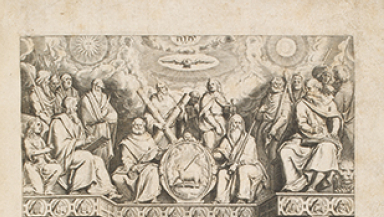
The Bible collection of Dr Charles Ryrie is to be sold by the prestigious Sotheby's auction house in December.
Ryrie, who died in January, was a theological teacher and proponent of dispensationalist theology who influenced thousands of theological students. His Ryrie Study Bible sold around 2,600,000 copies and was a standard work in evangelical homes.
Ryrie was also an avid collector of rare Bibles and manuscripts. Sotheby's has described the sale as one of the greatest private collections of printed and manuscript Bibles formed since the 19th century.
The around 200 lots of manuscript and printed Bibles range from the 10th-century 'Benton Gospels in Greek' (estimate $50/$80,000), to a beautifully illuminated 13th-century Italian manuscript Bible in Latin (estimate $150/250,000), to two leaves surviving from the Gutenberg Bible, printed in Mainz about 1454 (estimate $50/70,000 each).
However, at the core of the collection are early English translations of the Bible, including multiple very rare early editions of the Coverdale and Tyndale versions. Rremarkably, the Ryrie Collection includes a manuscript of John Wycliffe's New Testament, produced in England about 1430 (estimate $500/800,000).
The collection also contains the tallest copy of the Authorised or King James version of the Bible, from the library of Louis Silver (estimate $400/600,000). Other languages are represented as well, including German, Spanish, Italian, Irish, Welsh, and the Indian Massachusett language – the latter the first Bible printed in America, translated into Massachusett by John Eliot.
Sotheby's spokesman Selby Kiffer said: "It is a testament to Charles Ryrie's personal modesty that, despite his myriad accomplishments, he was not widely known as a book collector. The wider world first learned of the remarkable collecting achievement of Dr Ryrie through the 1998–99 exhibition, Formatting the Word of God, at the Bridwell Library of Southern Methodist University. But that exhibition, remarkable as it was, featured fewer than half of the volumes in Dr Ryrie's collection and none of his extraordinary letters and documents signed by theological figures such as Martin Luther, John Calvin, and John and Charles Wesley. When the full extent of his collection – astutely gathered over the course of more than five decades – is revealed, it will surely be acknowledged as a string of bibliographical pearls of great price."
The family of Charles Ryrie has expressed their hope that his books and manuscripts will go to other collectors who will treasure them as much as he did, saying: "While our father's collecting was largely a private endeavour, he keenly enjoyed sharing his books and knowledge with a small group of collectors, libraries, and dealers. We are sure that he would be pleased to know that his collection will now go to other collectors just as dedicated and as passionate he was."