For all its greatness, America could collapse and be defeated by Islam just like what happened to the thousand-year-old Byzantine Empire, biblical scholar Eddie Hyatt warns.
Writing for Charisma News, Hyatt notes that the Christian Byzantine Empire was one of the most powerful and vast empires the world has ever known.
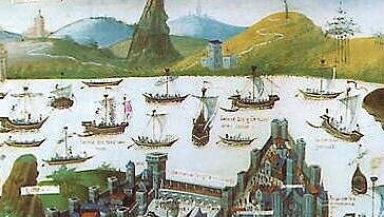
According to historical accounts, the Byzantine Empire was the continuation of the Roman Empire in the East during Late Antiquity and the Middle Ages. Its capital city was Constantinople (modern-day Istanbul). It survived the fragmentation and fall of the Western Roman Empire in the 5th century AD and continued to exist for an additional thousand years until it fell to the Muslim Ottoman Turks in 1453.
During its reign, the empire was considered as the most powerful economic, cultural, and military force in Europe.
Hyatt says that the fall of the mighty Byzantine Empire should serve as a reminder to Americans that "we must not trust in our advanced technology, stock market wealth, or military might" since all these can be taken away by a determined foe, like today's Islamic radicals.
Hyatt cites three reasons why the Byzantine Empire fell to Muslim invaders: (1) The church's preoccupation with political power; (2) personal faith replaced with liturgical formalism; and (3) doctrinal rigidity and strife.
# 1. The church's preoccupation with political power:
Constantine founded the Byzantine Empire began at around A.D. 330. When the empire was beginning to unravel, Constantine saw Christianity as "the cord by which he could pull the Empire together."
He then began favouring Christians, "building them elaborate buildings and underwriting the salaries of their bishops whom he also exalted into positions parallel to the provincial governors of the Empire."
"Christianity thus became politicised" which eventually led to "political wrangling for church offices and power," Hyatt says.
"This preoccupation with political power and the divisions it produced weakened the church and the Empire and made both vulnerable to the Muslim invaders," he writes.
# 2. Personal faith replaced with liturgical formalism
With the church politicised, Christianity became institutionalised and "replaced with outward form and ritual."
Constantine began constructing church buildings to accommodate the religious gatherings of Christians. Bishops began wearing distinctive clothing to indicate their superior rank, Hyatt says.
"Lacking a church with the strength and vitality of a personal, dynamic faith in Jesus, the Empire found itself weakened and vulnerable when Islam came with its armies," he writes.
# 3. Doctrinal rigidity and strife
The Christian church's rise to political affluence and power led to "fierce doctrinal battles" and "violent struggles" leading to "sharp divisions in the church," Hyatt says.
A seemingly trivial doctrinal difference led to a major source of strife and division, eventually leading to a formal division of East and West when, in 1054, Rome and Constantinople formally excommunicated each other.
This division drastically weakened both side, making it easier for the Ottoman Turks to invade and conquer what was once a mighty Christian empire.