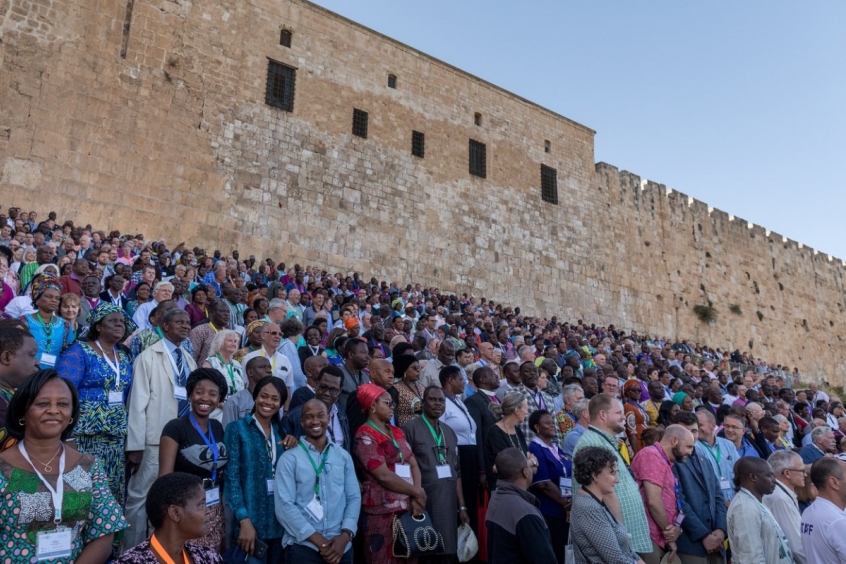
The party is over. Around 2,000 delegates from around the world have returned home from Jerusalem after the third international gathering of the Global Anglican Future Conference, known generally as 'GAFCON'.
The organisation, set up in 2008 in reaction to an alleged liberal drift in official Anglican structures, seems to be in good heart. But how strong is it really? Justin Welby recently described it as 'a ginger group' – while by contrast, GAFCON's website claimed its convocation was 'the largest international gathering of Anglicans in 50 years'.
There are different ways of measuring strength and power, of course. One statistic which has been doing the rounds online is a table claiming to show that 71 per cent of Anglicans were represented in Jerusalem. This calculation is arrived at by totalling up membership of the 'GAFCON provinces' as a proportion of the worldwide Anglican Communion.
It's a slightly odd set of figures – in that the Church of England apparently has 25 million members (presumably the number baptised), of whom 20 million are then discounted for being 'inactive'. And Tanzania's 3.6 million Anglicans are included, even though that country's primate, Mambo Mndolwa, decided not to attend. Furthermore, it is hardly likely that all the 22 million Anglicans in Nigeria listed in the table are fully-informed, enthusiastic GAFCON supporters who were waiting on tenterhooks for every bulletin from Jerusalem.
Of course God himself doesn't seem to rate the strength of his people by their numbers. Indeed, Gideon in the Old Testament is told to dispense with some of his team (Judges 7) because with a larger number they might fall into the trap of thinking their victories were down to them, rather than the Lord. More generally, God seems to have a special heart for 'remnants' (Isaiah 10). So all in all I don't think we should set much store by membership figures as a sign of strength and power. They are interesting, for sure, but nothing more. Moreover, there's something a bit distasteful about a 'my organisation is bigger than yours' approach which smacks faintly of worldly machismo.
A better indication of an organisation's strength is the ability it demonstrates to successfully carry out its plans. In GAFCON's final communiqué, Justin Welby is urged to invite bishops from the GAFCON provinces of North America and Brazil as 'full members' to his Lambeth 2020 global conference, even though neither region is officially part of the Anglican Communion in the archbishop's eyes. He is also exhorted not to invite bishops whose churches have contravened the 1998 Lambeth resolution on sexual issues 'unless they have repented...and reversed their decisions'.
'In the event that this does not occur,' the GAFCON statement continues, 'we urge GAFCON members to decline the invitation to attend Lambeth 2020 and all other meetings of the Instruments of Communion.' So will that happen? Will the GAFCON bishops and archbishops really boycott these events if this request is turned down? It will be interesting to see. This could be a good indication of the political strength of the organisation in practice.
Another key indicator of strength for a Christian group is its spiritual life and vibrancy. One observer at GAFCON, Gerald McDermott, Anglican chair at Beeson Divinity School, an interdenominational US seminary, has written that spiritual fervour in the Global South means simply that 'the future of the Church is here'. And thus he describes GAFCON's new general secretary Archbishop Ben Kwashi as 'the most powerful man in the Anglican world'.
Ultimately, God seems to measure power and strength not by any worldly standards of numbers or even success, but by the nature of the gospel that is preached. As the apostle Paul puts it, some want a message of signs, and others crave a gospel of human wisdom, 'but we preach Christ crucified...Christ the power of God and the wisdom of God'. It is, he says, the gospel that 'is the power of God that brings salvation to everyone who believes'.
GAFCON's letter says of the gospel that it 'is the life-transforming message of salvation from sin and all its consequences through the death and resurrection of the Lord Jesus Christ. It is both a declaration and a summons: announcing what has been done for us in Christ and calling us to repentance, faith and submission to his Lordship... It is addressed to men, women and children and it is our only hope in the light of the final judgment and the reality of hell.' That seems to be a robust reiteration of the power of the gospel and a succinct expression of long-established Christian belief.
Ultimately, then, it is the gospel that provides the power to churches. And so wherever this gospel is proclaimed in Spirit-filled, culturally-sensitive (but not culturally-compromised) ways, both by ordinary church ministers and by bishops and other leaders, then the church has strength and power. That's true for every denomination – Anglican or non-Anglican – and it's true for any Christian group, whether few or many in number. The gospel is the power that counts. Nothing else makes a difference eternally.
David Baker is a former daily newspaper journalist now working as an Anglican minister in Sussex, England. Find him on Twitter @Baker_David_A