Julian of Norwich was an enigmatic character. The first known woman to write in English, she was a mediaeval "anchoress" or hermit, who lived from 1342 to around 1416. But her work didn't become known until much later; the language was updated and her book – Revelations of Divine Love – reissued in 1901, when it became a huge success. She's now recognised as one of England's most important mystical writers.
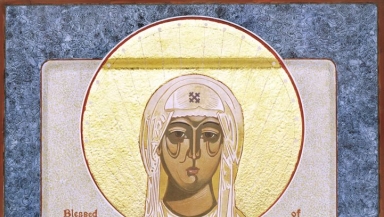
Revelations is based on a series of visions of God Julian received while seriously ill. When she recovered, she recorded these 16 "showings", and later expanded their account into a much longer text.
Though written centuries ago, they contain deep truths about God that can speak to us today of His character and faithfulness.
God as mother
Julian referred to Jesus as the mother of Christians. Divine love, she said, is like motherly love. The bond between Christians and God is like the bond between mother and child. "When contemplating God's love as that of a mother, she [Julian] can appeal to modern readers searching for a religious view that draws on both male and female", says Janina Ramirez in her book Julian of Norwich: A very brief history (SPCK, 12.99).
Backlash received by US blogger Rachel Held Evans for referring to God as "she" in 2012, then, was perhaps better directed at Julian.
"Jesus Christ therefore, who himself overcame evil with good, is our true Mother," Julian wrote. "We received our 'Being' from Him and this is where His Maternity starts. And with it comes the gentle protection and Guard of Love which will never ceases to surround us.
"Just as God is our Father, so God is also our Mother."
God's enduring and sustaining love
One of Julian's most famous analogies stemmed from her vision of a hazelnut in the palm of her hand, from which she placed emphasis on the enduring and sustaining love of God for everything He has made.
"In this little thing I saw three properties," she wrote. "The first is that God made it. The second that God loves it. And the third, that God keeps it."
She noted the fragility of the nut, "I was amazed that it could last, for I thought that because of its littleness it would suddenly have fallen into nothing," but was immediately granted understanding: "It lasts and always will, because God loves it, and thus everything has being through the love of God."
All shall be well
We perhaps need to hear this more than ever. In a time of deep uncertainty in the US, a seemingly endless war in Iraq and Syria, and resulting humanitarian crises, Julian's famous assertion that, "All shall be well, and all shall be well and all manner of thing shall be well" may bring some comfort. In fact, these words are enshrined in a stained glass window at the Chapel Royal in St James' Palace, where the Queen herself goes to pray.
During Julian's lifetime, the Bubonic Plague ravaged England, killing a third of its population. During her own illness, she was at one point thought almost dead, and a priest read her the last rites. She understood suffering well, and was not speaking from a place of only ever having known happiness.
Yet in one vision, she said Christ reminded her: "You will not be overcome. God did not say you will not be troubled, you will not be belaboured, you will not be disquieted; But God said, You will not be overcome."