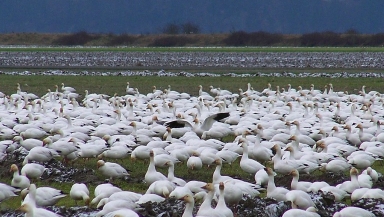
Thousands of geese fell out of the sky in a matter of days in Idaho in what is suspected to be an outbreak of avian cholera.
The bacterial infection can cause lesions and organ hemorrhages, and is highly contagious. "Death may be so rapid that birds literally fall out of the sky or die while eating with no previous signs of disease," according to the National Wildlife Health Center (NWHC).
Idaho Department of Fish and Game spokesman Gregg Losinski reported that at least 2,000 dead snow geese migrating to nesting grounds in Alaska were found near bodies of water and a wildlife management area in eastern Idaho. Dozens of workers and volunteers collected and burned the carcasses.
"Basically, they just fell out of the sky," Losinski said.
Biologists were awaiting laboratory results to confirm that avian cholera was the cause of mass deaths, which is spread by contact with secretions or waste of infected birds, ingestion of infected food or water, aerosol transmission, or bird-to-bird contact.
Avian cholera is primarily caused by Pasteurella multocida Type 1, which can live in soil and water for up to four months. Humans are at limited risk of contracting the disease, according to Losinski.
The snow geese were traveling from wintering grounds in the southwest and Mexico, and headed to the northern coast of Alaska. It is unclear where they became infected.
About 20 bald eagles were spotted near the geese carcasses, but it is unknown whether they are infected because the disease has an incubation period of 5 to 8 days, according to The Poultry Site.
"Careful carcass collection and disposal helps reduce the amount of bacteria in the environment," the NWHC said.